
I once spent an entire Sunday afternoon arguing with a mate about whether the Bills-Chiefs game would go over 52.5. He was convinced that two high-powered offences guaranteed a shootout. I pointed out that both teams had elite defences that season, the wind in Buffalo was gusting over 30 mph, and the total had already moved down from 54. The game finished 20-17. He bought the next round.
That argument captures everything useful about NFL totals betting — it forces you to think about the game differently. Instead of picking a winner, you are analysing tempo, weather, defensive matchups and coaching tendencies. It is a fundamentally different skill from moneyline or spread betting, and for analytical minds, it is often the most satisfying market on the board. Live and in-play betting now accounts for 62.35% of online sports betting revenue, and totals markets are a major driver of that figure because the total shifts with every possession.
This guide breaks down how NFL totals are priced, what moves them, and where the genuine edges hide for UK punters betting through regulated bookmakers.
NFL Totals Pricing: Securing Better Odds at UK Sites
The first totals line I ever studied properly taught me something counterintuitive: the number is not a prediction. I had always assumed bookmakers set the total at where they genuinely expected the combined score to land. They do not. The opening total is set where the bookmaker expects to attract equal money on both sides, which is a subtle but critical distinction.
The process starts with quantitative models. Oddsmakers feed in each team’s points scored per game, points allowed, offensive and defensive efficiency ratings, pace of play, red zone conversion rates, and turnover margins. These models produce a raw number — say, 47.3. The trading team then adjusts for factors the model cannot capture: a key injury announced after the model ran, a coaching change, or a specific game-script expectation. If one team is a heavy favourite, the model accounts for the likelihood that the leading team runs the ball in the fourth quarter, slowing the pace and suppressing the total.
Once the opening number is posted, it moves based on betting action and new information. If 70% of the money comes in on the over, the total ticks up — from 47.5 to 48, then 48.5. The bookmaker is not reacting to public opinion as such; they are managing liability. Each half-point movement represents real money flowing in one direction.
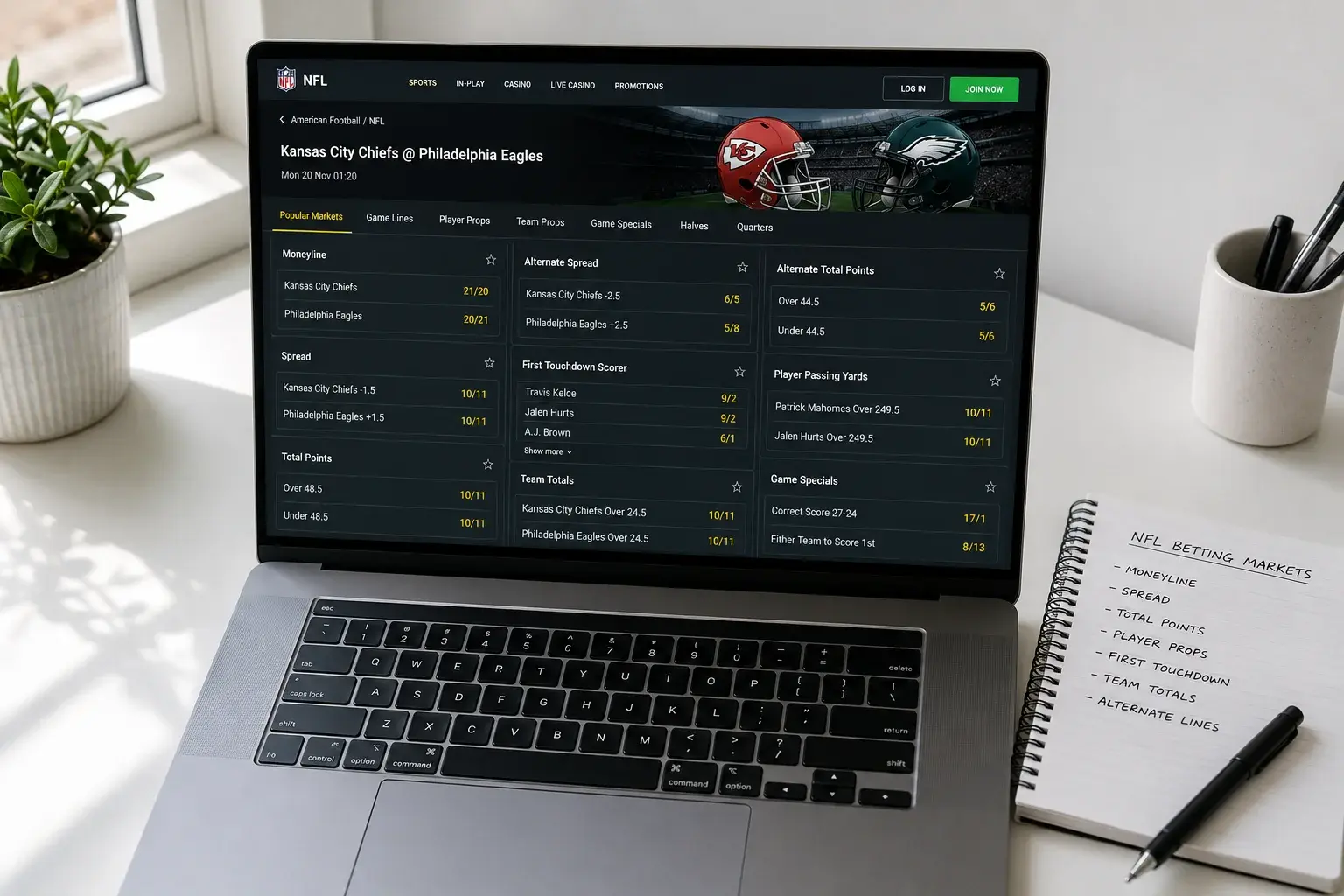
Pricing works on the same vig structure as other markets. A standard totals line looks like Over 47.5 (-110) / Under 47.5 (-110) in American odds, or roughly 1.91/1.91 in decimal. The bookmaker’s margin sits in that gap between true probability and offered odds. Some UK bookmakers price totals at slightly different margins depending on the game’s profile — primetime games and playoff matches often carry tighter margins because they attract higher volume.
One thing worth understanding early: totals are quoted in half-points to eliminate pushes. You will occasionally see whole-number totals (47.0 rather than 47.5), and in those cases a combined score landing exactly on 47 results in a push — your stake returned, no win, no loss. Most bookmakers prefer the half-point because it forces a binary outcome, which simplifies their risk management.
Weather, Pace and Personnel: What Shifts the Total
Three seasons ago I backed the over in a December game at Soldier Field, completely ignoring the forecast. Temperature at kickoff was -8C with 40 mph gusts. The game finished 9-6. It was a stupid bet in hindsight, but it drilled into me that weather is not a secondary factor in totals betting — it is often the primary one.
Wind is the biggest suppressor. Anything above 15 mph measurably reduces passing efficiency, and since passing produces more points than running, sustained wind pushes games under. Rain and snow have a similar but slightly less dramatic effect; fumbles increase, field goals become less reliable, and both teams tend to lean on conservative run-heavy game plans. If you see a late-week weather forecast calling for severe conditions at an outdoor venue, check whether the total has already moved. If it has not, you are looking at a potential edge on the under.
Pace of play varies enormously across NFL teams. Some offences run 70 plays per game; others average 58. When two up-tempo teams meet, the game features more possessions, more scoring opportunities, and a structurally higher total. When two grind-it-out teams meet, the reverse applies. The NFL ran a record seven international games in 2025, and those London fixtures often produced unusual pace dynamics — teams adjusting to jet lag and unfamiliar conditions tended to play more conservatively in the first half before opening up later.
Personnel changes deserve close attention in the days before kickoff. A starting quarterback going down to injury can move a total by three or more points overnight. But it is not just the quarterback. Losing a top wide receiver or a key offensive lineman can suppress scoring just as effectively, and those injuries do not always move the line as aggressively — which is where informed bettors find value. Defensive injuries matter too: if a team’s best pass rusher is ruled out, the opposing offence becomes more efficient, nudging the total upward. For more granular in-game analysis, live betting on NFL matches lets you react to these dynamics as they unfold during the game itself.
Team Totals and Alternate Lines
Most UK bettors know the standard game total, but team totals are a different proposition entirely — and one I lean on heavily. A team total is the bookmaker’s line on how many points a single team will score, independent of the opponent’s total. If the game total is 47.5 and one team is favoured by 6.5, the implied team totals sit around 27 for the favourite and 20.5 for the underdog.
Why bother with team totals when you could just bet the game total? Isolation. Suppose you are convinced that one team’s offence will dominate but you have no strong view on the other side. Betting the game total forces you to take a position on both offences and both defences combined. A team total isolates your thesis. I find this especially useful in games with a large spread, where the favourite’s scoring is relatively predictable but the underdog’s output is a coin flip.
Alternate totals give you a different kind of flexibility. Instead of the standard 47.5, you might take Over 43.5 at reduced odds or Over 51.5 at enhanced odds. The pricing reflects the adjusted probability. Alternate lines are particularly useful in accumulators, where taking a lower alternate total at short odds adds a high-confidence leg without drastically reducing the overall payout. They also work well when you have a strong directional view but want a margin of safety — backing Over 41.5 instead of Over 47.5 gives you six extra points of cushion.
A word of caution on alternate totals: the bookmaker’s margin widens as you move further from the central line. Over 55.5 might look tempting at 4/1, but the implied probability already accounts for how unlikely that outcome is, and the vig embedded in the price is larger than at the standard line. Use alternate totals as precision tools, not as lottery tickets.
Scoring Trends Across the NFL Season
Here is a pattern most casual bettors miss entirely: NFL scoring is not uniform across the season. Early-season games tend to produce higher totals because defences are still gelling, offences are running their freshest schemes, and players are at peak fitness with fewer accumulated injuries. By mid-season, defences have more game film to study, coordinators adjust, and scoring typically dips.
Then something interesting happens in December and January. Scoring drops further in outdoor cold-weather venues but often spikes in dome and warm-weather games as playoff-chasing teams become more aggressive. The NFL generates a larger share of betting handle than any other sport in regulated markets — a single Sunday regularly produces more wagering volume than entire weeks of MLB or NBA action — and that concentration means totals lines in the late season are priced very efficiently. Early-season totals, by contrast, carry more uncertainty because the sample size of current-season data is tiny.
Week 1 is a special case. Bookmakers set opening totals using pre-season projections, which are inherently noisier than mid-season models built on actual results. The public tends to overreact to off-season narratives — a team that added a star receiver gets hammered with over money regardless of whether the offensive line can protect the quarterback long enough to throw. I have found genuine value fading the hype in Week 1 totals, particularly for teams with new coaching staffs still installing their systems.
Playoff totals follow a different logic again. Stakes are higher, game plans are more conservative, and both teams have had an extra week (or more) to prepare specifically for their opponent. Historically, playoff games trend slightly under their posted totals. The Super Bowl is a notable exception — the extended preparation period and the spectacle of the event often produce well-executed offensive football. But even there, the pattern is inconsistent enough that you should bet each game on its specific merits rather than relying on a blanket trend.