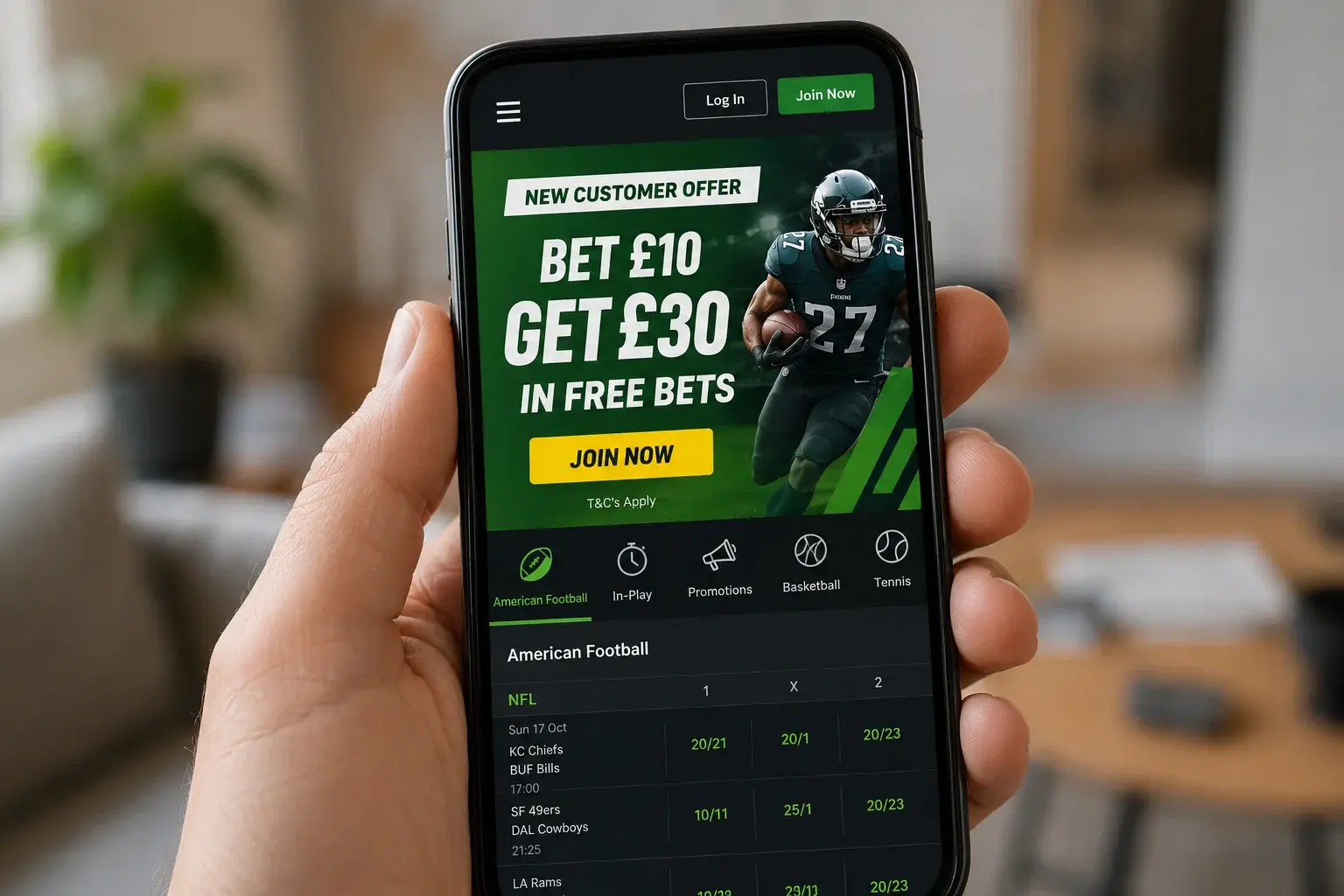
Let me tell you about the “free” bet that cost me £40. Years ago, a bookmaker offered a £20 free bet upon depositing £20. I took it, wagered the free bet on an NFL underdog, won, and then discovered that the original £20 stake was not returned with the winnings — only the profit portion. Then I found out the profit had a 35x wagering requirement before I could withdraw. By the time I cleared it, I had staked over £700 in qualifying bets and ended up net negative. The free bet was never free. It was a marketing funnel. Before claiming any promotional offers, make sure you understand how the recent UKGC gambling reforms might affect your account limits.
That experience made me obsessive about reading terms and conditions, which is exactly the mindset every UK NFL bettor should bring to promotional offers. The regulatory landscape shifted dramatically on 19 January 2026, when the Gambling Commission banned mixed promotional bonuses and capped wagering requirements at x10. The new rules make promotions more transparent, but “more transparent” still does not mean “free money.”
Welcome Bonuses: Claiming Offers at UK NFL Betting Sites
A welcome bonus is the operator’s cost of acquiring you as a customer. They calculate that the lifetime value of your betting activity will exceed what they give away upfront, and they are almost always right. Understanding this dynamic does not mean you should ignore bonuses — it means you should use them with your eyes open.
The standard structure works like this. You register a new account, deposit a qualifying amount (typically £10 to £20), and place a qualifying bet that meets minimum odds requirements (usually 1/2 or 1/1). Once that bet settles, the bookmaker credits your account with a free bet token — anywhere from £10 to £50, depending on the operator and the promotion. The free bet has an expiry window, usually seven to thirty days.
The critical mechanic: most free bets are “stake not returned.” If you place a £20 free bet at odds of 2/1 and it wins, you receive £40 in profit but not the original £20 token. Your net gain is £40, not £60. This is standard across virtually every UK bookmaker, and it is the single most misunderstood element of welcome bonuses. People see “£20 free bet” and think they have £20 to play with. They do not. They have a token that returns profit on winning bets, and the expected value of that token depends entirely on the odds at which it is used.
For NFL betting specifically, welcome bonuses are most useful when timed to the start of the season or a major event like the Super Bowl. Operators frequently enhance their standard offers around these peaks, adding boosted odds or additional free bets for NFL markets.
Wagering Requirements: The x10 Cap and Mixed-Promo Ban
Before January 2026, wagering requirements were the wild west. I tracked operators setting requirements at 30x, 40x, and in extreme cases 50x the bonus amount. A 40x requirement on a £10 bonus meant staking £400 in qualifying bets before withdrawing any bonus-derived winnings. The maths made most bonuses negative-value propositions for anyone who actually ran the numbers.
The Gambling Commission’s new rules changed two things simultaneously. First, all wagering requirements are now capped at ten times the bonus amount. A £10 bonus requires a maximum of £100 in turnover before withdrawal. That is still not trivial — you need to stake £100 on markets where the bookmaker has a built-in edge — but it is a substantial improvement on the old regime. The expected value of a bonus with a 10x requirement is meaningfully higher than one at 40x, because you lose less to the overround across fewer qualifying bets.
Second, mixed promotional bonuses are banned. Operators can no longer bundle sports free bets with casino free spins or bingo credits. Every promotional offer must be specific to a single product category. For NFL bettors, this means the welcome offer is a sports betting promotion and nothing else. No more “bet £10 on the NFL and get 50 free spins on a slot” — a combination that was designed to funnel sports bettors into higher-margin casino products.
Both changes trace back to the 2025 UKGC reforms and the broader implementation of the 2023 Gambling White Paper. The intent is consumer protection: making promotions easier to understand and harder to exploit on the operator side. Whether you view that as the regulator being helpful or paternalistic depends on your perspective, but the practical effect for NFL punters is clearer terms and lower hurdles.
NFL-Specific Promotions: Early Payouts, Acca Boosts and Cashback
Welcome bonuses get the headlines, but the ongoing promotions throughout the NFL season are often more valuable in aggregate. Three types dominate the UK market.
Early payout offers settle your moneyline bet as a winner if the team you backed takes a lead of a certain number of points — typically 14 or 17 — at any stage during the game, regardless of the final result. With $30 billion wagered legally on the 2025 NFL season in the US alone, operators have the volume data to price these promotions with precision. The early payout is not charity — it is a calculated cost that the bookmaker absorbs because it drives customer loyalty and increased handle.
Acca boosts add a percentage to your accumulator winnings based on the number of legs. The standard structure scales from around 5% for three legs up to 50% or more for eight-plus legs. The boost percentage looks generous, but remember that the base probability of an eight-leg acca landing is minuscule. The boost is most valuable on shorter accumulators where the win probability is still realistic — a 10% boost on a three-leg treble is worth more in expected terms than a 50% boost on a bet that wins one time in four hundred.
Cashback promotions return a percentage of net losses over a defined period, usually a week. If you lose £50 across a Sunday of NFL betting and the cashback rate is 10%, you receive £5 back as a free bet or cash credit. These are the closest thing to a genuine rebate, though the returned amount is always a fraction of the loss and usually comes with its own wagering conditions.
Reading the Terms: What to Check Before Claiming
I have a five-point checklist that I run through every time a new promotion crosses my screen. It takes less than two minutes and has saved me from wasting stakes on worthless bonuses more times than I can count.
Check the minimum odds requirement. Many free bet offers require your qualifying bet to be placed at minimum odds of 1/2 or 1/1. If you planned to back a heavy NFL favourite at 1/5, that bet will not qualify, and you will have spent your deposit without triggering the bonus.
Check the expiry window. Free bets typically expire in seven to thirty days. If you receive a free bet in August and the NFL season does not start until September, a seven-day expiry forces you to use it on a sport you did not intend to bet on.
Check whether the free bet is stake-returned or stake-not-returned. This distinction changes the expected value of the token dramatically. Stake-returned is rare and much more valuable.
Check market restrictions. Some promotions exclude certain bet types — player props, bet builders, or in-play markets might not qualify. If your primary NFL betting activity centres on props, a free bet that only works on pre-match moneylines is less useful than it appears.
Check payment method restrictions. Deposits made via specific e-wallets are occasionally excluded from promotional eligibility. The bookmaker wants debit card deposits because they signal higher engagement. If you deposit via PayPal or Skrill and the terms exclude e-wallets, you will not receive the bonus regardless of everything else. Discover the most lucrative welcome bonuses by visiting our leading NFL betting guide tailored for British punters.