
The UK NFL Betting Market: Bookmaker Comparison
I placed my first NFL wager from a flat in Clapham in 2014 — a moneyline on the Seahawks in Super Bowl XLVIII. The odds were short, the payout was modest, and I had no idea what I was doing. Twelve years and several thousand NFL bets later, I make my living dissecting point spreads, tracking line movement and modelling implied probability for UK punters who want more than a gut feeling on a Sunday night accumulator. This guide is everything I wish someone had handed me back then.
The UK's NFL betting market has shifted from a niche curiosity to a genuine segment of the sports wagering landscape. The numbers tell the story faster than I can: 14.3 million NFL fans now live in Britain — nearly one in five adults. The domestic gambling industry is worth north of £16 billion in annual gross gambling yield, with remote sports betting alone contributing £2.6 billion. And on the other side of the Atlantic, the American Gaming Association pegged legal NFL wagering at $30 billion for the 2025 season, a figure that reverberates into every UK bookmaker's NFL pricing model.
14.3M
NFL fans in the UK
£16.8B
UK gambling industry GGY (2024-2025)
$30B
Legal NFL wagers, 2025 season
What follows is not a list of bookmakers or a collection of referral links. I have built this guide around the data, regulation and strategic frameworks that actually move the needle for UK-based NFL bettors heading into the 2026 season. Every claim is backed by a number. Every section exists because it fills a gap I have seen across years of reading — and being disappointed by — the competition. Whether you are placing your first spread bet or refining a Kelly Criterion staking plan, the structure below will get you where you need to be.
The Numbers, the Rules and the Strategy in 90 Seconds
- The UK gambling industry posted £16.8 billion in GGY for 2024-2025, with 37.4 million active online accounts and a projected CAGR of 12.8% through 2030 — NFL betting sits inside one of Europe's most competitive markets.
- Five core NFL bet types — spread, moneyline, totals, props and futures — form the foundation; live in-play wagers now generate over 62% of online sports betting revenue.
- UKGC reforms in 2025-2026 introduced financial vulnerability checks at £150 net deposits per 30 days, a mixed-promo ban and a x10 wagering cap that reshape how bonuses work.
- Bankroll discipline — flat staking at 1-2% per bet, a fixed season budget, monthly ROI reviews — separates sustainable bettors from those who blow through their balance by Week 6.
- The NFL's integrity infrastructure, including the 2023 player suspension wave and Genius Sports monitoring, underpins market reliability for UK punters.
The UK's NFL Betting Market in Numbers
A few years ago, I could walk into a press event about UK sports betting and not hear the letters N-F-L mentioned once. The conversation was Premier League, horse racing, the occasional tennis major. That has changed — and the Gambling Commission's own data explains why the shift matters more than any marketing campaign.
The UK gambling industry posted £16.8 billion in gross gambling yield for the twelve months ending March 2025, a 7.3% increase year on year. Online gambling — remote casino, betting and bingo combined — generated £7.8 billion of that total, growing at 13.1% and now accounting for 46% of the entire market. Within the online segment, remote sports betting contributed £2.6 billion in GGY, with football (the round-ball kind) taking £1.3 billion and horse racing claiming £766.7 million. NFL does not get its own line item in the Gambling Commission's breakdown, but the trajectory of the sport's UK audience tells you where the growth runway sits.
UK Gambling GGY Breakdown (Apr 2024 - Mar 2025)
Total industry GGY: £16.8 billion (+7.3% year on year). Online gambling: £7.8 billion (46% of total, +13.1%). Remote sports betting: £2.6 billion. Active online accounts: 37.4 million — a 24.1% increase over pre-pandemic levels. Projected CAGR for UK online gambling through 2030: 12.8%.
Those 37.4 million active online accounts represent a 24.1% jump compared with pre-Covid figures, and the market is forecast to grow at a compound annual rate of 12.8% through 2030. That is the macro picture. The NFL-specific picture is equally striking.
Britain is home to approximately 14.3 million NFL fans — nearly one in five people in the country. The demographic skews young and digitally native: 68% of UK NFL fans fall between 18 and 44 years old, which is exactly the bracket most comfortable with mobile wagering, live markets and same-game parlays. Henry Hodgson, the General Manager of NFL UK and Ireland, put it plainly when describing the league's position here: the sport is healthy in Britain, but clearly has enormous room to grow, and the focus now is reaching more people through media partnerships and grassroots participation.
UK-based users generate approximately 1.2 million NFL-related search queries every month — a volume that dwarfs most other American sports in Britain and signals sustained, year-round interest beyond just the Super Bowl window.
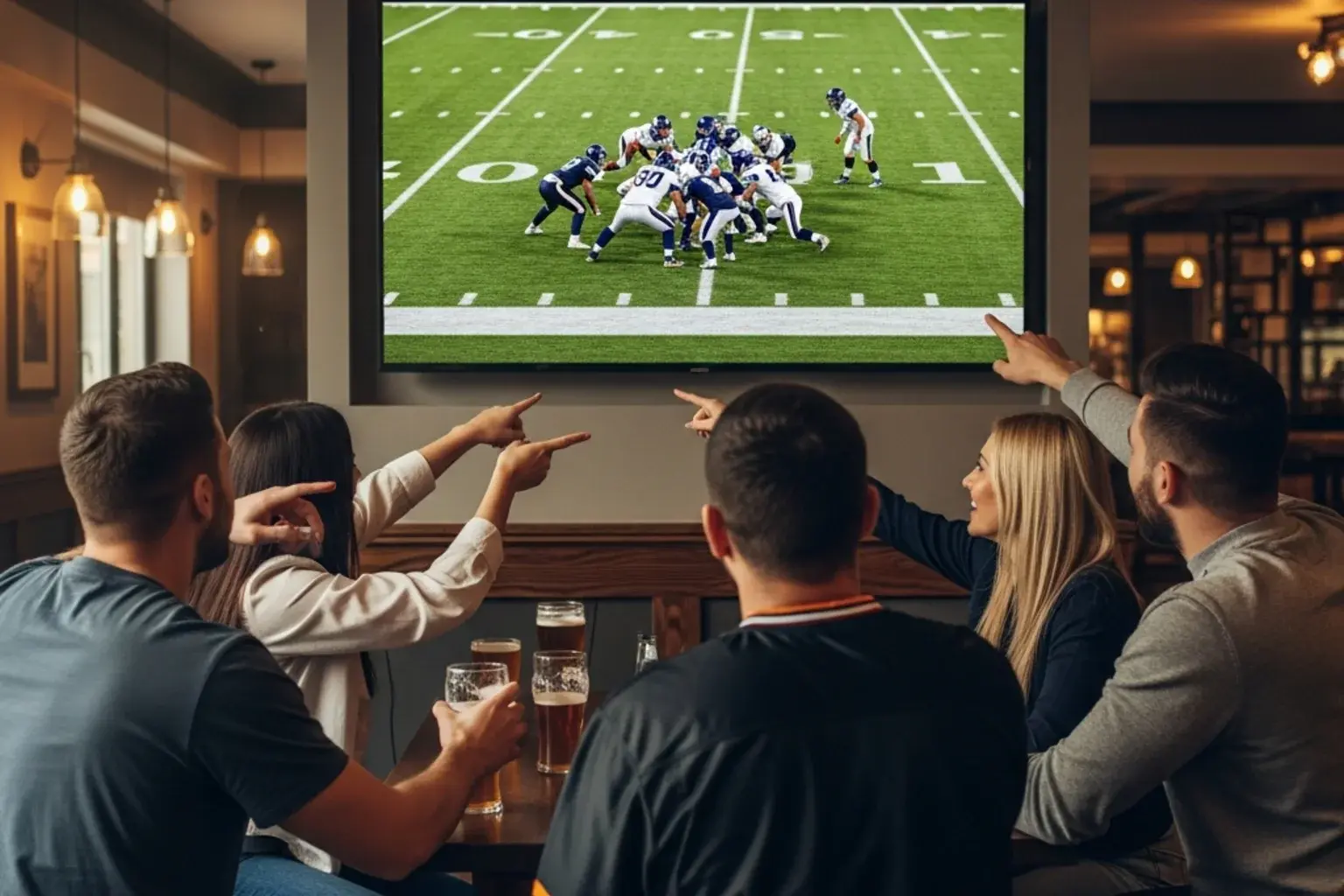
The search data matters because it reveals intent. Those 1.2 million monthly queries are not idle curiosity; they represent people actively looking for odds, bet types, streaming options and strategy content. For the bookmakers, each search is a potential customer acquisition event. For you, it means the market is deep enough to support competitive pricing, diverse NFL coverage and promotions that did not exist even three seasons ago. This is no longer a sport that UK sportsbooks cover reluctantly — it is a segment they are actively investing in.
Free Play Extractor
How NFL Odds Work at UK Bookmakers
The first time I tried to explain NFL odds to a mate who had only ever bet on the Premier League, I watched his eyes glaze over the moment I mentioned "minus one-ten." He knew fractional odds inside out — 5/1, 11/4, evens — but the American format might as well have been algebra. That conversation taught me something I still apply: the odds themselves are not complicated, but the fact that three different formats coexist in NFL betting confuses people far more than any market type ever does.
UK bookmakers display NFL odds in fractional format by default. That is the system you already know from horse racing and Premier League accumulators: the first number tells you the profit relative to the second number, which is your stake. A price of 5/2 means £5 profit for every £2 wagered, returning £7 in total. Simple enough.
Fractional odds — the traditional UK format expressed as a ratio (e.g. 5/2). The numerator is your potential profit; the denominator is the stake required.
Decimal odds — the format favoured across continental Europe and increasingly popular in the UK. The number represents the total return per unit staked, including your original stake (e.g. 3.50 means £3.50 back on a £1 bet).
American odds — the default in US sportsbooks, expressed as a positive or negative number. A positive figure (+200) shows profit on a £100 stake; a negative figure (-150) shows how much you must stake to win £100.
Decimal odds strip away the ratio and give you the total return per unit staked. The same 5/2 price becomes 3.50 in decimal — meaning a £1 bet returns £3.50 (your £1 back plus £2.50 profit). Most UK platforms let you toggle to decimal in settings, and I would recommend doing so if you are comparing lines across multiple bookmakers, because decimal makes the maths faster.
American odds are the format you will encounter on US-facing coverage, NFL podcasts, and any content sourced from American sportsbooks. A positive number like +200 tells you the profit on a hypothetical £100 stake (£200 profit, £300 total return). A negative number like -150 tells you how much you need to risk to win £100 (stake £150, get back £250). The critical thing to remember: American odds centre everything around a £100 baseline, which makes them intuitive once the logic clicks, but alien until it does.
Sports betting accounted for 56.64% of the UK's online gambling revenue in 2024 — the single largest segment. That dominance means the pricing infrastructure is mature, competitive and worth understanding properly. For a deeper breakdown of conversion formulas, implied probability and where to find the sharpest NFL lines in Britain, I have written a dedicated guide to NFL odds at UK bookmakers that works through every calculation step by step.
| Format | Favourite | Underdog |
|---|---|---|
| Fractional | 4/9 | 7/4 |
| Decimal | 1.44 | 2.75 |
| American | -225 | +175 |
Example: a hypothetical NFL match with one clear favourite. A £10 bet on the favourite at 4/9 returns £14.44. The same £10 on the underdog at 7/4 returns £27.50.
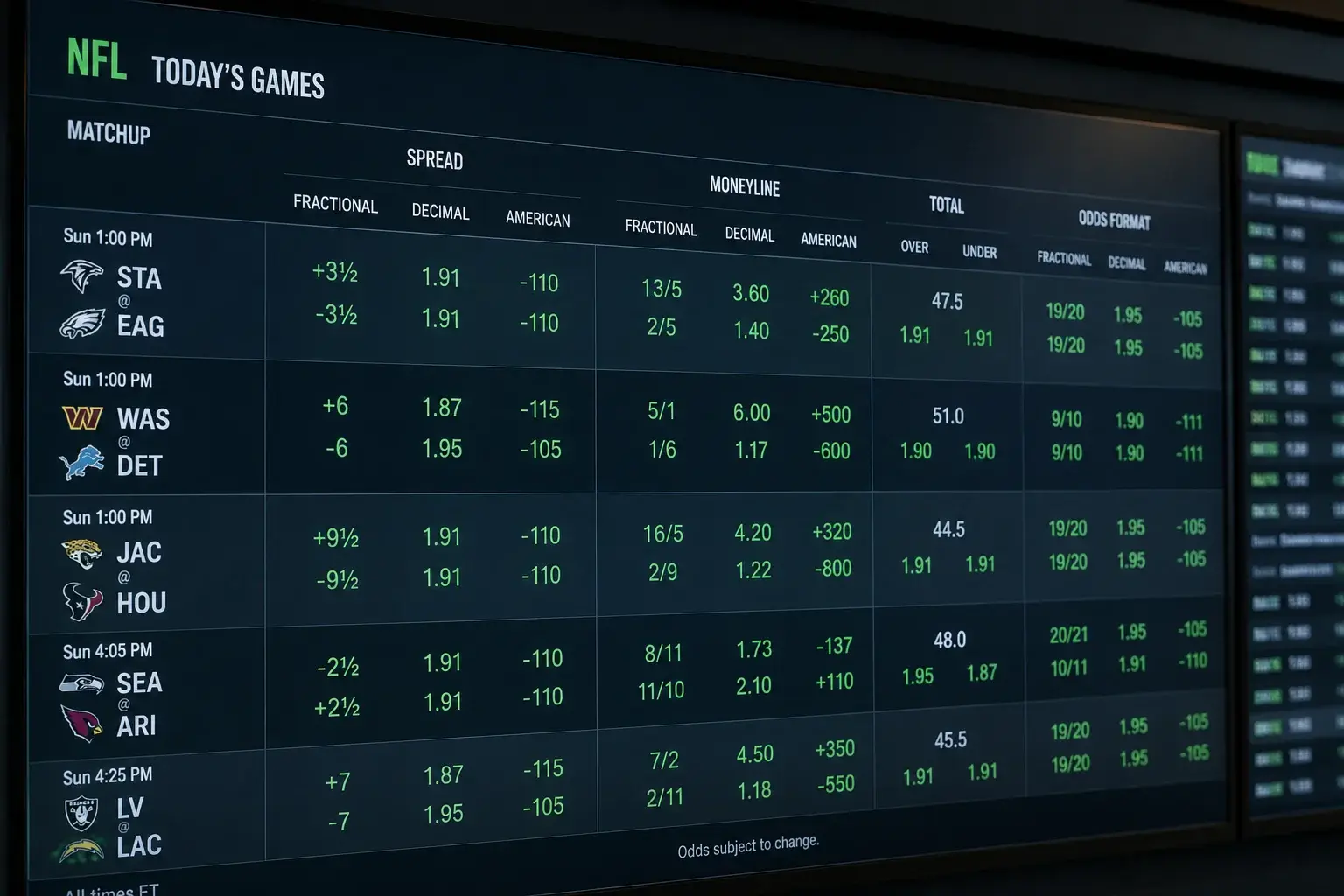
| Feature | UK Default | US Default |
|---|---|---|
| Odds format | Fractional (e.g. 5/2) | American (e.g. +250) |
| Implied probability visibility | Requires conversion | Requires conversion |
| Most intuitive for | Profit-to-stake ratio | Baseline £100 wagers |
| Toggling available | Yes, at most UK bookmakers | Rarely at US sportsbooks |
NFL Bet Types Every UK Punter Should Know
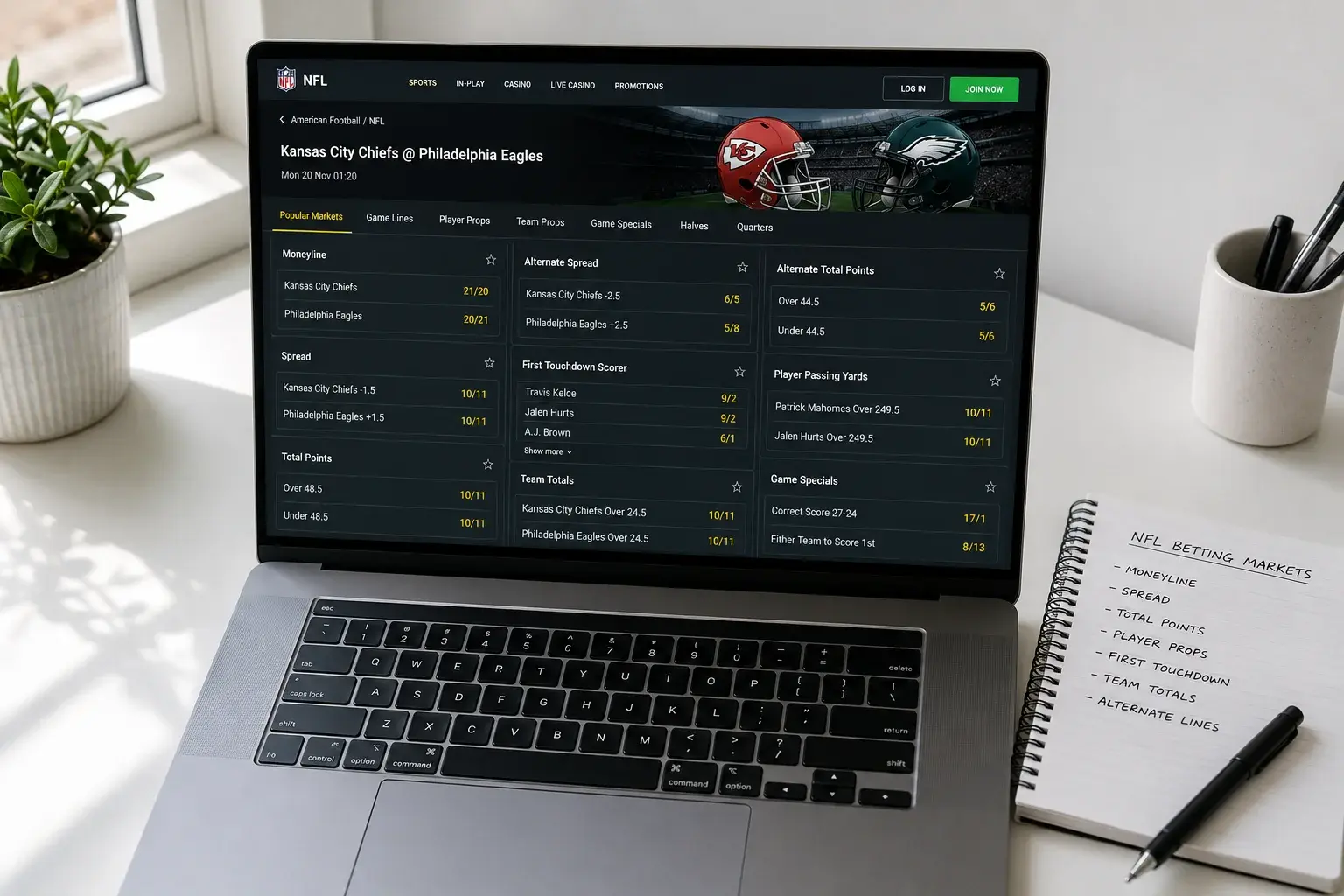
I remember the 2018 season when a colleague who had been betting on horse racing for decades asked me what a "prop" was. He had been wagering on NFL match results for years without ever realising there were thirty or more markets available per game. That is the reality for a lot of UK punters — you land on the moneyline or the spread and never look further. What follows is a map of the five core bet types you will encounter on any UKGC-licensed platform. Each one has its own risk profile, margin structure and strategic value, and understanding the full set changes how you approach a Sunday slate.
Point spread — a handicap applied to the favoured team, expressed as a negative number (e.g. -3.5). The favourite must win by more than the spread for the bet to pay out.
Moneyline — a straight bet on which team wins the game, with no spread involved. Odds are adjusted to reflect the relative strength of each side.
Totals (over/under) — a wager on whether the combined score of both teams will finish above or below a line set by the bookmaker.
Props (proposition bets) — wagers on specific events within a game, such as a player's passing yards, a team's first-half score, or the method of the first scoring play.
Futures — long-term bets placed on outcomes that will not be decided for weeks or months, such as the Super Bowl winner, conference champion, or season MVP.
Point Spread
The spread is the backbone of NFL wagering in both the US and UK markets. When a bookmaker sets a line of -6.5 on a team, they are saying that team must win by seven or more points for a spread bet to pay out. The half-point eliminates the possibility of a push (a tie against the number), which is one reason you will see .5 lines far more often than whole numbers in NFL markets. UK bookmakers typically present this as a "handicap" — same concept, different label. If you are coming from Premier League betting and have used Asian handicaps, the mechanics are nearly identical. For a thorough breakdown of how spread lines are set, how they move, and when to bet against the number, I have a full guide to NFL point spread betting in the UK.
Moneyline
Moneyline is the simplest NFL bet: pick the team that wins. No margin, no spread, no maths beyond reading the odds. The catch is price. Backing a heavy favourite on the moneyline often returns very little relative to risk — a team priced at 1/5 (decimal 1.20) needs to win five times for every loss just to break even. Where moneyline becomes genuinely interesting is on underdogs and close matchups, where the gap between the spread price and the moneyline price creates different risk-reward profiles for the same game. You do not always need to beat the spread; sometimes, backing a team at +350 to win outright is the sharper play.
Totals (Over/Under)
A totals bet ignores which team wins and focuses entirely on how many points both sides score combined. If the bookmaker sets a line at 47.5, you are wagering on whether the final combined score will be 48 or more (over) or 47 or fewer (under). Totals pricing is influenced by offensive and defensive rankings, pace of play, weather conditions — a rain-soaked game at an outdoor stadium in December tilts the maths towards the under. I lean on totals when I have a strong read on game script but no confidence in the winner.
Player and Game Props
Adam Schefter, ESPN's senior NFL insider, summed it up neatly: for any sport, the player prop markets are where the real interest lies. Props let you wager on individual performances — a quarterback's passing yards, a running back's rushing touchdowns, a wide receiver's receptions — or on game-level events like the first scoring method or the team that scores last. UK bookmakers have expanded their NFL prop offerings dramatically over the past three seasons, and platforms now routinely list 30 or more prop markets per fixture. The margins on props tend to be wider than on match-result markets, so the research burden is higher, but so is the edge when you find a mispriced line. For a full breakdown, see my guide to NFL prop bets in the UK.
Futures and Outrights
Futures are season-long wagers: Super Bowl winner, conference champion, regular-season MVP, division winners, total wins over/under. The appeal is price — backing a team at 25/1 in July to win the Super Bowl offers returns you will never see on a weekly match bet. The cost is liquidity. Your money is locked in for months, and the line moves constantly as the season unfolds. I treat futures as a small, deliberate allocation within a broader bankroll, not a replacement for week-to-week analysis.
Live NFL Betting: In-Play Markets and Timing
Picture this: it is a Thursday night in October, the fourth quarter is underway, and the pregame spread you liked at -3.5 has shifted to +1.5 because the favourite turned the ball over twice in the third. That is when the in-play market comes alive. I started betting NFL live games around 2016, and the shift from static, pregame-only wagering to real-time pricing felt like upgrading from a still photograph to a video feed. The numbers confirm the appeal is widespread: in-play wagering now accounts for the majority of online sports betting revenue and is growing faster than any other segment. For NFL specifically, the structure of the game — discrete plays, natural stoppages, momentum swings — makes it one of the best sports on the planet for live markets.
Live Betting Revenue Share
In-play wagers generated 62.35% of online sports betting revenue in 2025, with a CAGR of 13.62%. NFL's stop-start format creates more pricing windows per game than most continuous-play sports, making it a natural fit for live markets.
UK bookmakers typically offer live markets on the match spread (updated drive-by-drive), next scoring play, current-quarter totals, next team to score, and a rotating selection of player props that shift as the game unfolds. The range of live markets has deepened significantly; where you once had three or four in-play options during an NFL game, most licensed UK platforms now offer fifteen to twenty, depending on the fixture's profile.
Bill Miller, the president and CEO of the American Gaming Association, captured the trend's momentum when he noted that fans now have more ways than ever to responsibly engage with the sport through legal wagering, and that betting enhances the competition and traditions that make NFL games special. That framing matters — the industry is building infrastructure around live engagement, not treating it as an afterthought.
Timing is where live NFL betting rewards discipline. The three highest-value windows I have found over a decade of in-play wagering are: the opening drive (market overreaction to early scores), the two-minute drill before half-time (bookmakers reprice aggressively under time pressure), and the fourth quarter when a trailing team shifts to pass-heavy offence and the totals line moves fast. Each window offers different risk — opening-drive bets are speculative, fourth-quarter bets are data-rich but volatile.
Latency matters. There is always a delay between what you see on screen and the odds your bookmaker is offering. If you are watching via a streaming feed from a betting site, the lag can be five to fifteen seconds behind the live broadcast. That gap is where mispriced bets live — but also where accepted-price traps catch you out. Never assume the live odds you see are the odds you will get. Always check the confirmed price before your slip is settled.
For a full breakdown of in-play market types, cash-out mechanics during live NFL wagers and strategies for each timing window, my guide to NFL live betting in the UK covers it all.
NFL Season Calendar and Its Impact on Betting Windows
My betting activity follows a clear seasonal rhythm, and after ten years of tracking it, I can tell you exactly when the profitable windows open and close. The NFL is not like the Premier League, where matches run almost continuously from August to May. American football compresses its action into defined phases — and each phase creates a distinct betting environment with different market depth, different data availability and different edges.
Preseason
August. Limited markets, experimental rosters.
Regular Season
September - January. 18 weeks, peak market depth.
Playoffs
January - February. Six rounds, tightening odds.
Super Bowl
February. Single-game event, maximum prop variety.
Preseason runs through August and is, frankly, a trap for most bettors. Starters play limited snaps, coaching staffs are experimenting with schemes and the sample size of meaningful data is close to zero. I stay away from preseason wagering almost entirely, with rare exceptions when a specific backup quarterback battle creates a mispriced player prop.
The regular season — 18 weeks from September through early January — is where the real work happens. Market depth is at its peak: spreads, totals, props, futures, live markets, bet builders, all available across every fixture. By Week 4 or 5, enough data exists to start modelling performance trends with reasonable confidence, and that is usually when my weekly research process kicks into full gear. The structure also creates natural inflection points: bye weeks reduce the slate and concentrate betting volume on fewer games, while divisional matchups late in the season carry playoff implications that shift lines more aggressively than neutral-site games early on.
The playoffs shrink the calendar dramatically — six rounds over five weeks, culminating in the Super Bowl. Odds tighten because the remaining teams are closely matched, bookmaker margins narrow on headline markets (the competition for Super Bowl betting volume is fierce), and the concentration of public attention means sharp money has to work harder to find mispriced lines.
The NFL staged a record seven regular-season games outside the United States in 2025, including fixtures at Wembley and Tottenham Hotspur Stadium. Since 2007, more than 39 regular-season games have been played on British soil — giving UK fans direct access to live NFL action and bookmakers a reason to price London fixtures with extra promotional support.
The off-season — roughly February through August — is not dead time for NFL wagering. Futures markets remain open year-round, and specific events like free agency, the NFL Draft and organised team activities (OTAs) create information catalysts that move outright lines. I find some of the best futures value in March and April, when roster moves and draft selections shift a team's projected win total before the broader market has recalibrated.
Bankroll Management for NFL Wagers
I blew through my first NFL bankroll in six weeks. It was 2015, I was staking 10% of my balance on individual games, and a three-week losing streak wiped me out before Halloween. That failure taught me more about NFL betting than any winning run ever has — specifically, that the edge in this market is not about picking winners. It is about surviving long enough for your edge to compound.
Bankroll management starts with a number: your season budget. This is the total amount you are prepared to allocate to NFL wagering from Week 1 through the Super Bowl, and it must be money you can lose entirely without affecting your life. Not savings, not rent, not next month's utility bills. Once that figure is set, you divide it into units. A standard approach is 1-2% of your bankroll per bet — so a £1,000 season budget means individual wagers of £10 to £20. The moment you start chasing losses with larger stakes, you are no longer managing a bankroll. You are gambling on gambling.
The UK regulatory environment reinforces this discipline whether you want it or not. Since February 2025, operators have been required to run financial vulnerability checks when a customer's net deposits reach £150 within a 30-day window. That threshold is low enough that even modest NFL bettors will trigger it during a busy week of fixtures. Rather than resenting the checks, I treat them as a built-in circuit breaker — if your deposits are crossing that line regularly, your staking plan needs revision.
Do
- Set a fixed season budget before Week 1 and stick to it through February.
- Use flat staking (1-2% per bet) until you have at least a full season of tracked results.
- Record every wager — stake, odds, market, result — in a spreadsheet or dedicated app.
- Review your ROI monthly, not weekly. Small samples lie.
Don't
- Increase unit size after a winning week. Variance works in both directions.
- Chase losses by doubling stakes on Monday Night Football after a bad Sunday.
- Stake more than 5% of your bankroll on any single wager, including "locks."
- Treat futures bets as free money — they tie up bankroll for months.
Pre-Bet Bankroll Checklist
- Is this stake within my 1-2% unit range?
- Have I checked my net deposits against the £150/30-day threshold?
- Am I betting because I have an analytical reason, or because I want action?
- If this bet loses, does my remaining bankroll support at least 30 more wagers this season?
- Have I logged this wager in my tracking system before placing it?
For a detailed comparison of flat staking versus the Kelly Criterion, schedule-based factors that influence timing, and a framework for identifying value in NFL lines, my NFL betting strategy guide takes the bankroll principles above and applies them to real matchup analysis.
UKGC Regulation: What Changed in 2025-2026
If you had asked me five years ago whether UK gambling regulation would directly affect how I place NFL bets, I would have said not really — the rules felt like background noise for anyone who stuck to licensed operators. That is no longer true. The reforms rolled out between 2025 and early 2026 have changed the mechanics of depositing, the structure of promotional offers and the compliance obligations operators carry. If you bet on the NFL from a UK account, you need to understand what shifted.
Financial Vulnerability Checks
Since 28 February 2025, UKGC-licensed operators must conduct financial vulnerability assessments when a customer's net deposits hit £150 within any rolling 30-day period. The checks are designed to identify affordability risk before harm escalates, and they apply across all sports betting — NFL included.
The £150 net-deposit threshold is the headline change. In practice, it means that a punter depositing modest amounts across a busy NFL weekend can trigger enhanced due diligence within days. The process varies by operator — some use open banking data with your consent, others request documentation — but the result is the same: a friction point between you and your next bet. I have seen it slow down withdrawals as well, particularly at operators whose compliance teams are still scaling to handle the volume.
The second major shift hit on 19 January 2026, when the Gambling Commission's ban on mixed promotional incentives took effect alongside a new wagering requirement cap of x10. Before this change, operators could bundle free-bet offers with casino bonuses, creating complex rollover structures that few customers fully understood. The x10 cap means that if you receive a £10 free bet, you need to wager a maximum of £100 before withdrawing any winnings derived from it. That is a meaningful improvement in transparency, and it directly affects how NFL welcome bonuses and acca-boost promotions are structured heading into the 2026 season.
Mixed-promo ban: what it means for NFL bonuses. Since January 2026, operators cannot combine sportsbook and casino incentives in a single promotional offer. Any NFL-specific welcome bonus must stand alone, with wagering requirements capped at x10. Check the terms carefully — operators that restructured their promotions late may still have legacy language in their T&Cs.
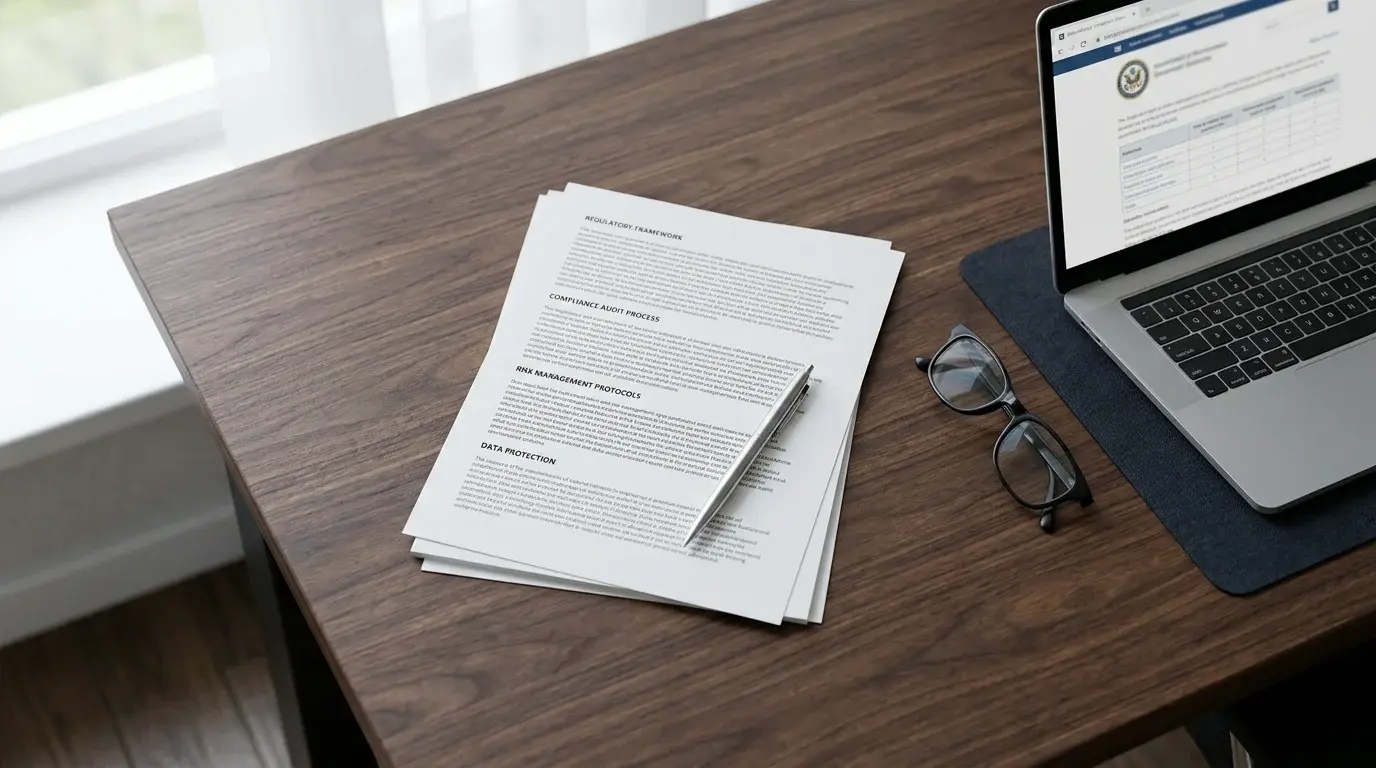
Behind the scenes, the funding model for the Gambling Commission itself has changed. A statutory levy on operators replaced the previous system of voluntary contributions, with the first invoices issued on 1 September 2025. Andrew Rhodes, the Commission's CEO, flagged that without this levy, critical investments in areas like illegal gambling investigations, criminal enforcement and data capabilities would have lost funding. The levy signals a regulatory body that intends to be more active, better resourced and less dependent on the goodwill of the industry it oversees.
The licensed operator count continues to fall. As of March 2025, there were 2,179 licensed operators in the UK — a 3.7% decline year on year. Consolidation is the dominant trend: smaller operators are merging, exiting or being absorbed by larger groups that can absorb the rising compliance costs. For punters, this means fewer but more heavily regulated choices. For NFL bettors specifically, the operators that remain are the ones investing most in market depth, live coverage and American sports content.
Responsible Gambling Tools and Data
I have watched friends lose control of their betting. Not in a dramatic, movie-scene way — it was gradual, quiet, and by the time anyone noticed, the damage was done. That experience is why I refuse to treat responsible gambling as a footnote. This section is short, but it matters more than anything else in this guide.
Ten percent of UK adults participate in online sports betting. That is roughly 5.3 million people. The vast majority do so without harm, but the Gambling Commission's own survey data confirms that problem gambling remains a persistent issue — and the treatment pipeline has gaps. The National Gambling Support Network reports that only 61% of patients complete their course of treatment for gambling-related harm. Nearly four in ten drop out before finishing. Those numbers should inform how you approach every tool described below.
If you or someone you know is experiencing gambling-related harm: GambleAware (0808 8020 133) provides free, confidential advice and can refer you to the National Gambling Treatment Service. GamCare (0808 8020 133) offers live chat, forum support and face-to-face counselling. The National Gambling Support Network coordinates treatment across the UK.
Every UKGC-licensed operator is required to offer a set of self-management tools. These include deposit limits (daily, weekly, monthly), session time reminders, cooling-off periods (24 hours to six weeks) and full self-exclusion through GAMSTOP, which blocks you from all licensed UK gambling sites for a minimum of six months. I use deposit limits myself — not because I have a problem, but because automating the boundary removes the decision from emotional moments. After a bad Sunday slate, the last thing I want is my own judgment standing between me and a reckless Monday night chase.
Treatment Completion Rate
Only 61% of patients complete gambling addiction treatment in the UK (averaged across 2021-2025). The gap between those who seek help and those who see it through underscores the importance of upstream prevention — deposit limits, session timers and reality checks — before harm escalates to a clinical level.
The tools exist. The data says they are underused. If you take one thing from this section, let it be this: set your limits before the season starts, not after the first losing week.
Betting Integrity: How the NFL Polices Wagering
In the spring of 2023, the NFL suspended ten players for violating its gambling policy within a three-month span. Ten players. Some had bet on NFL games from team facilities; others had placed wagers on their own team's matches. The story dominated headlines for weeks, and for the first time, a lot of UK punters I spoke with started asking whether the markets they were betting into were actually clean.
The short answer is yes — but the infrastructure behind that answer is worth understanding, because it directly affects the reliability of the odds you are pricing into your wagers.
NFL Player Suspensions Timeline
2023: Ten players suspended for gambling policy violations over three months — the largest enforcement wave in modern NFL history. 2024-2025: Zero suspensions. The crackdown, combined with updated education programmes, appears to have shifted player behaviour sharply.
The NFL's gambling policy prohibits all league personnel — players, coaches, staff — from betting on any NFL game, regardless of whether they have inside information or involvement in the outcome. The penalty structure is severe: a minimum one-year suspension for betting on a game involving your own team, and a minimum six-game suspension for betting on any other NFL game. The 2023 enforcement wave, followed by zero suspensions in the 2024-2025 window, suggests the deterrent is working.
On the monitoring side, the NFL partners with integrity providers — most notably Genius Sports, which holds the league's exclusive official data distribution rights — to track betting patterns across global markets in real time. Cathy Lanier, the NFL's Senior Vice President of Security, described the operation as looking for anything anomalous, anything that stands out, anything that might raise concerns. That means unusual line movement, irregular bet volumes from specific geographies, and patterns that do not match historical norms for a given matchup.
For UK bettors, this matters in a practical sense. The integrity monitoring layer means that the NFL odds you see at a UKGC-licensed bookmaker are priced on data that has been vetted for anomalies. It does not eliminate the possibility of manipulation — no system does — but it means the sport takes market integrity seriously enough to have invested in institutional infrastructure. When you compare that to leagues with weaker monitoring, the difference in pricing confidence is real.
NFL Betting in the UK — Frequently Asked Questions
Is NFL betting legal in the UK?
Yes. NFL betting is fully legal in the United Kingdom under the framework administered by the UK Gambling Commission. Any operator holding a valid UKGC licence can offer NFL markets to UK residents. You are not required to use a US-based sportsbook — in fact, using unlicensed offshore platforms means forfeiting the consumer protections that come with UKGC regulation, including dispute resolution, financial ring-fencing of player funds and mandatory responsible gambling tools. As long as you are 18 or older and using a licensed operator, you can bet on any NFL game, including regular-season fixtures, playoffs and the Super Bowl.
What types of bets can I place on NFL games?
UK bookmakers offer a wide range of NFL markets. The five core types are point spread (handicap), moneyline (match winner), totals (over/under combined score), props (individual player or game event outcomes) and futures (season-long markets like Super Bowl winner or MVP). Beyond these, most platforms provide bet builders, same-game parlays, half-time/full-time markets, quarter-by-quarter totals and specials around events like the NFL Draft or London Games. Market depth varies by operator and by the profile of the fixture — primetime games and playoff matches typically carry the most options.
How do NFL odds work at UK bookmakers?
UK bookmakers display NFL odds in fractional format by default (e.g. 5/2), though most platforms allow you to switch to decimal (3.50) or American (+250) formats in your account settings. All three formats express the same underlying probability — they just present it differently. Fractional odds show profit relative to stake, decimal odds show total return per unit staked, and American odds use a baseline of 100 to indicate either profit on favourites (negative numbers) or profit on underdogs (positive numbers). The bookmaker's margin — often called the overround or vig — is built into the odds regardless of format.
Can I watch NFL games live while betting in the UK?
Some UKGC-licensed betting sites offer live streaming of NFL games directly within their platforms, typically requiring a funded account or a recently placed bet on the relevant fixture. Coverage varies significantly by operator and by the broadcasting rights in play for each game. Outside of betting-site streams, UK viewers can access NFL through Sky Sports (which holds primary broadcast rights), NFL Game Pass, and occasional free-to-air coverage on Channel 5 and the BBC. If you plan to bet in-play, be aware that streaming feeds from betting sites carry a delay of five to fifteen seconds, which affects the accuracy of the live odds you see on screen.
What is the safest way to manage an NFL betting bankroll?
Set a fixed season budget before Week 1 — an amount you can afford to lose without any impact on your daily life. Divide that budget into units of 1-2% per bet. Use flat staking until you have at least a full season of tracked results to evaluate. Record every wager in a spreadsheet or tracking app, and review your return on investment monthly rather than weekly, because small samples produce misleading results. Use the deposit-limit tools available at every UKGC-licensed operator to automate your spending boundaries. If your net deposits cross the £150/30-day threshold that triggers financial vulnerability checks, treat it as a signal to reassess your staking plan.
Are there NFL-specific welcome bonuses at UK bookies?
Several UK operators offer promotions that apply to NFL betting, including free-bet credits, acca insurance and enhanced odds on selected fixtures. Since January 2026, the Gambling Commission's ban on mixed promotional incentives means that any sportsbook bonus must stand alone rather than being bundled with casino offers, and wagering requirements are capped at x10. NFL-specific promotions tend to peak during the regular season and around the Super Bowl. Always read the full terms before claiming — pay particular attention to minimum odds requirements, market restrictions and time limits on wagering.