
Numbers do not lie, but they do hide. Ask most people in the UK betting industry how big the NFL market is domestically and you will get vague hand-waves — “it is growing,” “American football is trending,” “the London games helped.” Those statements are all true, and they are all useless without figures behind them. I have spent the better part of three months pulling together data from the Gambling Commission, the American Gaming Association, NFL audience research, and industry analysts to paint a picture that actually quantifies what is happening.
The UK gambling industry posted £16.8 billion in gross gambling yield for the twelve months ending March 2025 — a 7.3% increase year on year. That is the total market. Within it, remote sports betting generated £2.6 billion in GGY, and NFL sits inside that figure as a growing but still minority sport. What follows is the data layer that nobody else in the UK NFL betting space has bothered to assemble.
UK Gambling Revenue: Betting Market Statistics
I keep a spreadsheet that tracks Gambling Commission annual reports going back to 2016. The trajectory is unmistakable. The industry’s £16.8 billion GGY in 2024-2025 is not just a post-pandemic recovery bounce — it represents structural growth driven by the shift from retail to digital.
Online gambling — encompassing remote casino, remote betting, and remote bingo — generated £7.8 billion of that total, a 13.1% increase year on year that brought its share to 46% of the entire market. Remote sports betting specifically accounted for £2.6 billion, with football dominating at £1.3 billion and horse racing contributing £766.7 million. NFL and other niche sports occupy the remaining segment, sharing it with tennis, cricket, golf, and everything else outside the big two.
The active account base tells its own story. UK online gambling accounts hit 37.4 million — a 24.1% increase compared to pre-pandemic levels. That figure includes dormant accounts and multi-platform users, so the number of unique individuals is lower. But the directional trend is clear: more people are betting online, more frequently, across more sports.
Meanwhile, the physical betting shop estate continues to shrink. Licensed bookmaker premises have fallen to 5,825, marking the eleventh consecutive year of decline. Every shuttered high-street shop represents customer activity migrating online, where NFL markets are available around the clock and the barrier to entry is a smartphone and a debit card.
NFL Fan Base in the UK: Who They Are and Where They Are
Henry Hodgson, the NFL’s General Manager for UK and Ireland, put it plainly when he said the league has been focused on identifying markets where it can build a sustainable fan base, not just play games. The UK is the clearest success story of that strategy.
Approximately 14.3 million people in the UK identify as NFL fans — nearly one in five adults. That figure comes from NFL-commissioned research and tracks closely with YouGov polling data that consistently places American football among the top five most-followed sports in the country. The demographic skew is striking: 68% of UK NFL fans fall in the 18-44 age bracket, making it one of the youngest-leaning major sports audiences in Britain. That matters enormously for betting operators, because the 18-34 demographic is the fastest-growing segment of online sports betting participation.
Search volume data reinforces the point. The UK generates approximately 1.2 million NFL-related searches per month, representing about 3% of the global NFL web audience by traffic volume. That percentage sounds small until you consider that the UK is competing against a domestic US audience of 330 million people who grew up with the sport. Three percent of global NFL attention, concentrated in a country of 67 million where American football had almost no presence twenty years ago, is a remarkable number.
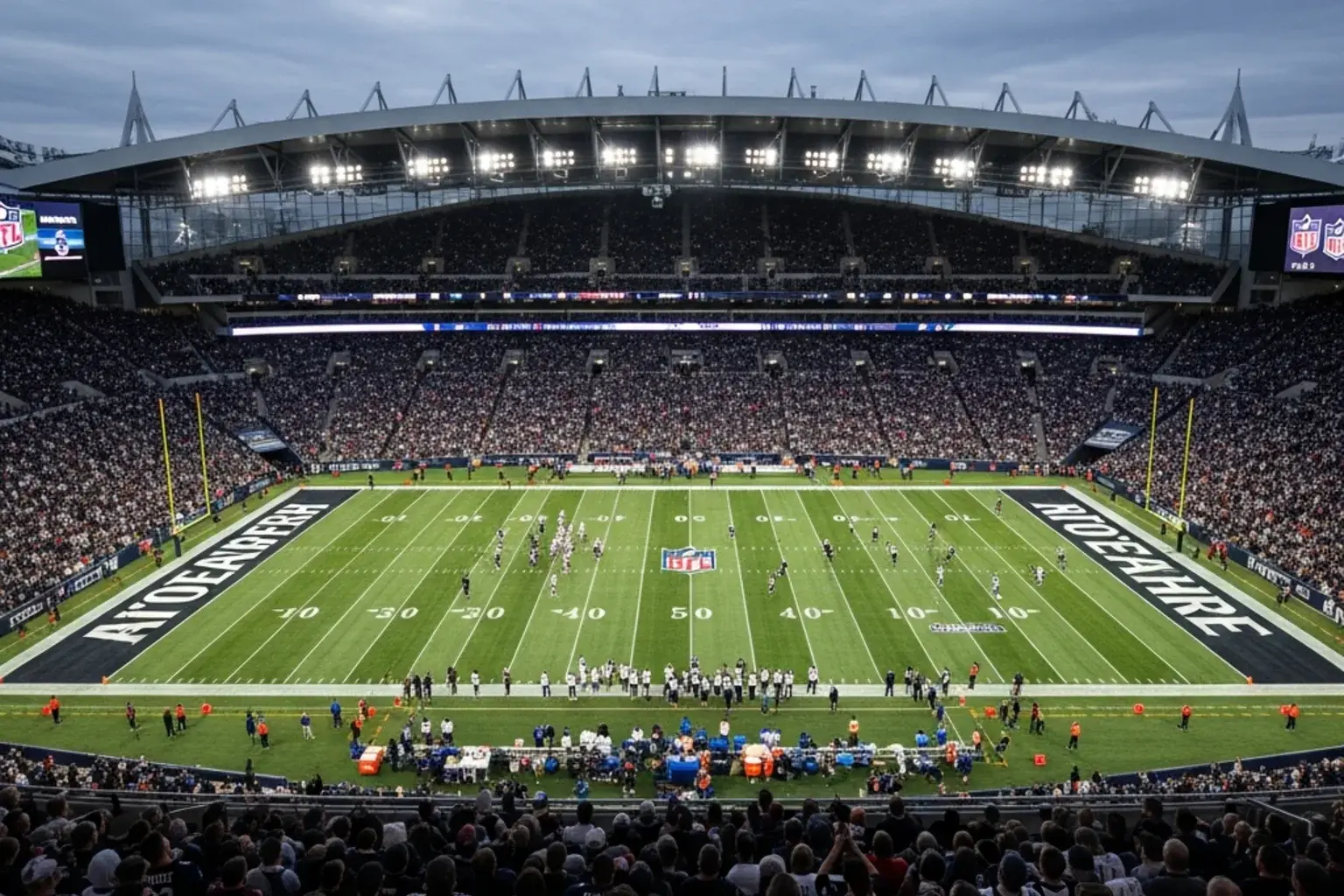
The London games have been central to this growth. Since 2007, over 39 regular-season NFL games have been played in the UK, with attendance at London venues ranging from 60,000 to 86,215. In 2025, more than 6 million people watched the London games on television or streaming platforms — a record for the series. That exposure converts casual viewers into fans, and fans into bettors, at a rate that no amount of marketing spend could replicate.
NFL Betting Handle in Global Context
The US numbers dwarf everything. The American Gaming Association estimated the legal handle on the 2025 NFL season at $30 billion, an 8.5% increase from $27.6 billion the previous year. Total US sports betting revenue reached $16.96 billion in 2025 on a handle of $166.94 billion, with the NFL commanding the single largest share of that volume. A single Sunday afternoon slot in the NFL consistently generates more betting handle than entire weeks of MLB or NBA regular-season action.
The global sports betting market sits at an estimated $125.12 billion in 2026, projected to reach $325.71 billion by 2035 at an 11.24% compound annual growth rate. The NFL is not solely responsible for that growth, but its international expansion — including the UK — is a meaningful contributor. Every London game, every Sky Sports broadcast, every flag football programme in a British school adds another node to the network of potential bettors.
The UK does not publish sport-specific betting handle data in the way the AGA does for the US. There is no public figure for “total GGY from NFL betting in the UK.” What we know is that remote sports betting generates £2.6 billion in GGY, that NFL is the fastest-growing American sport in UK betting portfolios, and that the demographic overlap between NFL fans and active online bettors is almost complete. The money is there. The data just has not caught up to the granularity we would want.
Growth Projections: CAGR and Market Drivers
Analysts project a 12.8% compound annual growth rate for the UK online gambling market between 2025 and 2030. That figure encompasses all remote gambling — casino, betting, bingo — but sports betting is expected to outpace the average, driven by mobile penetration, in-play wagering, and the continued shift from retail to digital.
Three factors will determine whether NFL betting captures a disproportionate share of that growth. First, media rights. The NFL’s current UK broadcast deal with Sky Sports, ITV, and Channel 5 puts games in front of audiences that have never previously had free-to-air access to American football. Every additional eyeball is a potential bettor. Second, the London Games series shows no signs of slowing — the NFL staged a record seven international regular-season games in 2025, and further expansion into new markets creates a flywheel where international interest feeds back into UK engagement. Third, the structural advantages of NFL betting itself: concentrated schedules, massive data availability, and a format that lends itself naturally to in-play markets, props, and same-game parlays.
The constraint is regulation. The 2025 UKGC reforms — financial vulnerability checks, promotional restrictions, the statutory levy — add friction and cost to the operator side. Those costs eventually show up in the odds, the promotions, or the range of markets offered. Growth will come, but it will be tempered by a regulatory environment that is deliberately designed to slow down the parts of the market that move too fast.