
I placed my first NFL spread bet in 2014 – a three-point line on a divisional matchup I was sure I understood. I lost by a hook. That half-point taught me more about spread betting than two years of watching American football ever did. The point spread is the single most traded market in NFL wagering, and for good reason: it levels the playing field between a 12-win powerhouse and a rebuilding squad, forcing you to think beyond “who wins” and into “by how much.” If you are unsure whether to take the points or back the outright winner, our guide on NFL spread vs moneyline betting will help you decide.
The American Gaming Association pegged legal NFL wagers at $30 billion for the 2025 season alone, and a significant share of that handle flows through spread markets. Here in the UK, where handicap betting has long been part of the football landscape, the NFL spread is a natural extension – yet the mechanics, the pricing and the timing carry subtle differences that catch newcomers off guard. This guide breaks down how point spreads are set, read, moved and – critically – exploited by disciplined UK punters.
Whether you have been betting on the Premier League handicap markets for years or you are opening an NFL spread line for the first time, the principles here apply across your entire season. I will walk you through the maths, the market dynamics and the mistakes I have made so you do not have to repeat them.
Point Spread Pricing: Finding Value at UK Bookies
A friend once asked me why the bookmaker does not just offer odds on who wins. The answer is simple: if one side attracts 90% of the money, the bookmaker’s risk is enormous. The point spread exists to split opinion roughly down the middle, and the way it gets there tells you a lot about how markets really work.
Every NFL spread starts with a power rating. Oddsmakers at major sportsbooks maintain proprietary models that assign a numerical strength to each of the 32 teams, updated weekly based on performance data, personnel changes and schedule context. When two teams are paired for a fixture, the difference between their power ratings produces a raw margin – say, 6.5 points. The home team typically receives a further adjustment, historically around three points, though that home-field number has been drifting lower league-wide for years. Combine the raw margin with the home-field adjustment and you get the opening line.
But that opening line is not the final product. Bookmakers release it to the market and then watch where money flows. If sharp bettors – syndicates, professional analysts, model-driven accounts – pile onto one side, the line moves. The spread is not a prediction of the final score difference. It is a price designed to balance liability. That distinction matters, and forgetting it is one of the most common conceptual errors I see among newer bettors.
In the NFL specifically, certain numbers carry more weight than others. Three is the most common margin of victory in professional American football, followed by seven. A spread of -3 or -7 is stickier than, say, -5 – bookmakers are reluctant to move through these key numbers because the percentage of games landing exactly on them is disproportionately high. If you see a line shift from -2.5 to -3.5 without pausing at -3, somebody with serious money forced that move, and it is worth paying attention to why.
One NFL Sunday generates more betting handle than an entire week of Major League Baseball or NBA action. That concentration of volume means NFL spreads are among the sharpest, most efficient lines in all of sports betting. Finding value is not impossible, but it requires more than a gut feeling about which quarterback looks good on television.
The vig – or juice, or overround, depending on which side of the Atlantic you grew up on – is the bookmaker’s margin built into spread pricing. At a US sportsbook, you will typically see -110 on both sides of the spread. At a UK bookmaker, that same pricing translates to roughly 10/11 fractional odds per side. The vig means you need to win more than 50% of your spread bets just to break even – the precise break-even rate at standard juice is 52.4%. Keep that number in your head. Every spread bet you place needs to clear that bar over time.
Reading NFL Spread Lines at UK Bookmakers
The first time I showed a UK mate an American sportsbook screen, he squinted at the minus signs and plus signs like I had handed him a chemistry equation. If you have spent years reading fractional odds on Premier League accumulators, the visual language of NFL spreads takes a moment to decode – but only a moment.
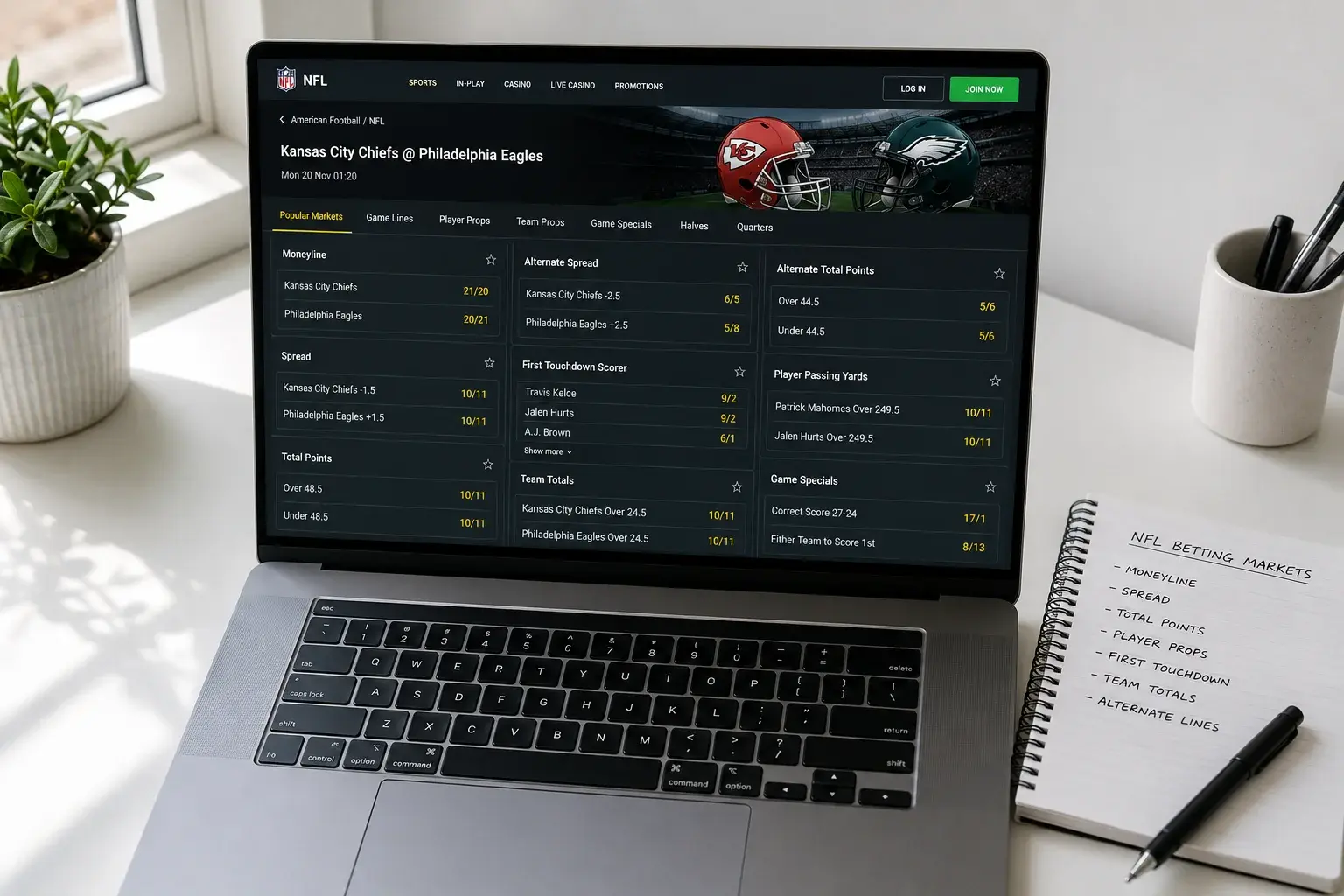
At most UK bookmakers, an NFL spread line looks something like this: Kansas City Chiefs -3.5 at 10/11, Cincinnati Bengals +3.5 at 10/11. The minus sign means the Chiefs are favoured and need to win by four or more points for your bet to land. The plus sign means the Bengals are the underdog – they can lose by up to three points and your bet still wins. That half-point eliminates the possibility of a push, which is a dead heat in UK parlance.
Some UK platforms display the same line in decimal format – Chiefs -3.5 at 1.91, Bengals +3.5 at 1.91. Others offer the American format natively, especially those with US-facing parent companies. Whichever format your bookmaker defaults to, the underlying bet is identical: you are wagering on the margin of victory, not the outright winner.
A whole-number spread – say, Chiefs -3 – introduces the push scenario. If Kansas City wins by exactly three, your stake is returned. No profit, no loss. Some bookmakers settle pushes as void legs in accumulators, which can quietly shrink your acca returns without a single leg technically losing. Always check the push settlement rules in the terms before you build multi-leg bets around NFL spreads.
When you see “alternate spreads” or “alternative handicaps” on a UK bookmaker’s NFL page, you are looking at the same underlying concept with different numbers. Instead of the market line of -3.5, you might take the Chiefs at -7.5 for a bigger price, or -1.5 for a shorter one. Alternate lines let you adjust risk and reward, and they are especially useful when you have a strong conviction about the scale of a result rather than just the direction. I use alternate spreads more often than most punters realise – they are one of the quieter edges available in the market.
Why NFL Spreads Move: Injury Reports, Weather and Sharp Money
I once watched a spread move from -1 to -3 in under two hours on a Tuesday morning. No injury news, no weather forecast change, no viral social media clip of a player limping. Just sharp money. That two-point swing on a quiet weekday told me everything I needed to know about which side the informed money was on – and it taught me that line movement is its own source of information, separate from anything you will find in a stat sheet.
Three forces drive NFL spread movement: injury updates, environmental factors and money flow. Of these, money flow is the most misunderstood. When a professional bettor places a large wager early in the week, the bookmaker adjusts the line to rebalance exposure. Other bookmakers see the move and follow. Within hours, a line that opened at -2.5 across the market can settle at -3.5. The casual punter who waits until Sunday morning sees a very different number than the one available on Tuesday.
Injuries are the most visible catalyst. When a starting quarterback is ruled out, the spread can swing by three to seven points depending on the quality gap between the starter and the backup. But intermediate injury designations – questionable, doubtful – create uncertainty that bookmakers price cautiously. The final injury report, released on Friday afternoon US time (late Friday evening here in the UK), is one of the most concentrated information drops in the NFL betting calendar. If a key player’s status changes from doubtful to active, the line will react before most recreational bettors even see the news.
Weather deserves its own attention, particularly for late-season games in open-air stadiums. Wind above 20 mph suppresses passing efficiency, which compresses scoring and often pulls totals down – but it can also shift spreads if one team relies more heavily on its aerial attack. Snow, freezing rain and extreme cold tend to favour running teams and defensive units, though the effect is less dramatic than casual bettors assume. I have seen punters overreact to a weather forecast so severely that the real value ends up on the opposite side.
Jamie Reynolds, a UK sports marketing consultant who has tracked the NFL fan culture here for years, has noted that British fans tend to be less tribally attached to specific teams than their American counterparts. That detachment is actually an advantage for spread bettors. If you do not have an emotional stake in the Chiefs or the Bengals, you can assess a three-point line on its merits without the cognitive bias that afflicts a lifelong fan. Tribal loyalty is the enemy of disciplined spread analysis – and UK punters start with a structural edge in that regard.
Reverse line movement – where the line moves in the opposite direction from the public betting percentages – is one of the more reliable signals in NFL markets. If 70% of tickets are on the Chiefs -3 but the line drops to -2.5, the bookmaker is telling you that the smaller number of Bengals bets carries more total money or comes from sharper accounts. I do not follow reverse line movement blindly, but I take it seriously as a filter. When my own analysis aligns with what the sharp money is doing, my confidence in the position goes up meaningfully.
Against-the-Spread Records and What They Reveal
Win-loss records lie. A team sitting at 10-4 straight-up might be 6-8 against the spread, which means the market has consistently overvalued them. Conversely, a 5-9 team can be 9-5 ATS – profitable to back week after week despite being objectively bad at football. The against-the-spread record strips away the narrative and shows you where the market has been wrong.
I keep a running ATS log throughout every NFL season, broken down by situation: home ATS, away ATS, as a favourite, as an underdog, after a bye week, in divisional games. The patterns are not always predictable, but they cluster in interesting ways. Teams coming off a bye week have historically covered at a higher rate, likely because the extra preparation time helps underdogs more than it helps favourites. Short-week games – Thursday Night Football in particular – tend to favour the home team ATS because travel fatigue compounds the disadvantage for the visiting squad.
One number I track obsessively: the ATS record of home underdogs. Across the last decade, home dogs in the NFL have covered the spread at a rate that consistently sits above 50%, making them one of the few systematic angles that has held up over time. The logic is straightforward – home underdogs are already getting points, and the crowd energy plus familiar surroundings give them a floor that the spread does not always account for. It is not a magic formula, but it is a starting point that has earned its place in my weekly process.
Public perception creates ATS distortions. High-profile teams with national television exposure attract disproportionate public money, inflating their spreads beyond what the on-field talent justifies. Meanwhile, small-market teams playing in unfashionable time slots get overlooked, and their spreads stay tight. The NFL generates the largest share of sports betting handle in the United States – dwarfing baseball and basketball on any given Sunday – and that volume magnifies the effect of public bias. More money on one side means a wider spread, which means more room for the other side to cover.
ATS records are retrospective, not predictive. A team that has covered seven straight spreads is not “due” to fail – that is gambler’s fallacy. What a strong ATS streak does tell you is that the market has been systematically mispricing that team, and unless the underlying reason has changed (a key injury, a scheme adjustment, a schedule shift), the mispricing may persist. Use ATS data to identify where the market is wrong, then verify the reason before committing your stake.
Spread Betting vs Moneyline: A Quick Comparison
Every week, someone asks me: should I take the spread or just back the winner? The short answer is that it depends on the size of the line and your confidence in the margin. When a spread sits at -1 or -1.5, you are essentially betting on the outright winner with a tiny cushion – and at that point, the moneyline on the favourite often offers poor value compared to the spread. But when the spread balloons to -10 or wider, the moneyline price on the favourite becomes so compressed that you are risking a lot to win very little, and the spread gives you a far better return for the same underlying opinion.
The practical difference boils down to risk profile. Spread bets pay at close to even money regardless of whether the team is a three-point or a fourteen-point favourite. Moneyline bets scale in price with the expected margin – a heavy favourite might be priced at 1/7, meaning you stake seven pounds to win one. Neither approach is inherently superior. I use moneyline bets when I expect a close game and want exposure to the outright result. I use spreads when I have a view on the margin or when the moneyline price is too short to justify the risk. For a more detailed framework on choosing between these two markets and totals, I have written a dedicated comparison of all three core NFL bet types.
Spread Betting Through Spreadex and Exchange Platforms
Most UK punters encounter NFL spreads through fixed-odds bookmakers – you back a team at -3.5 for 10/11 and your maximum loss is your stake. But there is another way to trade NFL spreads in the UK that most beginners overlook entirely, and it carries a fundamentally different risk profile.
Financial spread betting, offered by firms like Spreadex, works on a points-based system where your profit or loss scales with how far the actual result moves from the spread. If you “buy” a team’s supremacy at 3 points for two pounds per point and they win by ten, you profit fourteen pounds (seven points above your buy price, times two). If they lose by four, you lose fourteen pounds (seven points below, times two). There is no fixed maximum loss unless you set a stop-loss, and that distinction makes financial spread betting a materially different product from fixed-odds handicap betting.
The appeal is obvious: uncapped upside when your analysis is correct by a wide margin. The danger is equally obvious: uncapped downside when it is not. I have used financial spread betting selectively for games where I have a strong view on a blowout – say, a top defence facing a team starting a third-string quarterback – but I always set a stop-loss, and I never use it as my primary betting vehicle. The variance is simply too high for consistent bankroll management.
Flutter Entertainment, the parent company behind several of the UK’s largest bookmakers, generated a projected revenue north of two billion pounds from its UK operations in 2025. That scale means fixed-odds NFL spreads at major operators are competitively priced, with tight overrounds and consistent market depth. For most UK punters, fixed-odds spread betting through a standard bookmaker is the more practical choice. Financial spread betting is a specialist tool – powerful in the right hands, destructive in the wrong ones.
Betting exchanges offer a third path. On an exchange, you are not betting against the bookmaker – you are matching bets with other punters. Exchange spreads tend to have thinner margins because the platform charges a commission on winnings rather than building a vig into the odds. The trade-off is liquidity: NFL markets on UK exchanges are significantly thinner than Premier League markets, meaning you may not get matched at your preferred price, especially on early-week lines or less popular fixtures. I use exchanges when the fixed-odds line has moved past a key number and the exchange still offers the original price, but I do not rely on them as my primary route to market.
Five Spread-Betting Mistakes UK Punters Make
After a decade of watching UK punters approach NFL spreads, certain errors repeat with depressing regularity. I have made most of these myself at some point, which is how I know they sting.
Betting every game on the card. The NFL plays 16 games on a typical Sunday slate. That volume feels like 16 opportunities, but it is also 16 chances to be wrong. No edge exists across every matchup. I rarely find more than three or four spread bets per week where my analysis gives me genuine conviction, and even that number might be generous. Discipline means passing on the other twelve games, and that is harder than it sounds when the clock is ticking toward kickoff and you have not placed a bet all day.
Ignoring the hook. The difference between -3 and -3.5 is not cosmetic. Approximately 15% of NFL games land on a margin of exactly three points. If you routinely take -3.5 instead of shopping for -3 at another bookmaker, you are giving up value on a significant chunk of outcomes. Half-point line shopping is tedious, unglamorous work, and it will save you more money over a season than any single clever pick.
Chasing steam moves. When a line moves sharply, the instinct is to jump on the “smart” side before it moves further. But by the time you notice a steam move, the value that caused it has already been priced in. You are buying at the new price, not the old one. I follow line movement to understand market sentiment, not to chase it. If my pre-existing analysis agrees with the direction of the move, I may act – but the move itself is not the reason.
Overweighting last week’s result. Recency bias is the most persistent cognitive error in NFL spread betting. A team that lost by 30 in Week 8 is not necessarily a 30-point underdog in Week 9 – they might be facing a weaker opponent, getting a key player back from injury or simply regressing to their mean. The spread already accounts for recent performance. Your job is to assess whether it over- or under-accounts for it.
Neglecting the schedule context. A team playing its third road game in four weeks, on a short turnaround, after an emotional divisional rivalry, is not the same team that its season record suggests. Schedule fatigue, travel wear and emotional letdowns are real factors that the spread attempts to price – but often underprices. I spend more time studying the schedule context than the box score, and I believe that edge has been one of the more consistent advantages in my decade of NFL wagering.
Carrying the Spread Into Your Weekly Process
The point spread is not a prediction – it is a price. Treat it like one. Compare it across bookmakers, track how it moves through the week and measure your results against the closing line, not just the final score. If you consistently beat the closing spread – meaning you get a better number than where the line settles at kickoff – you are identifying value, and the profits will follow over a large enough sample. That is the benchmark I hold myself to, and it is the one I would encourage any serious UK NFL spread bettor to adopt. Finding the best handicap lines is crucial, which is why we recommend using a trusted NFL sports betting platform for your weekly picks.