
The bet that hooked me on NFL props was a rushing yardage line on a Thursday night game. I had no strong view on who would win or by how much, but I had spent an hour studying the defensive front the running back was about to face, and I knew the yardage number was too low. It cashed with room to spare, and it taught me something I have carried through every NFL season since: you do not need to predict the game to profit from it. Sometimes, you just need to predict what one player does in one specific matchup. Once you understand individual player markets, you can combine them using an NFL bet builder to increase your potential payouts.
Adam Schefter, ESPN’s senior NFL insider, has made the point that player props are where the sport gets truly interesting from a betting perspective. He is right, and the reason is structural. NFL props shift the analytical unit from the team – 53 players, a coaching staff, a scheme – to the individual. That narrower focus makes the research more manageable, the edges more identifiable and the results more satisfying when your homework pays off.
With $30 billion wagered on the 2025 NFL season in the US alone, prop markets have exploded in depth and variety. UK bookmakers have followed, and a Sunday slate at a major operator now offers hundreds of individual prop lines across the card. This guide covers what those markets look like, how they are priced, and how to research them without drowning in data.
Player Prop Markets: Betting on Yardage, Touchdowns and Receptions
Three categories dominate player prop betting in the NFL: yardage, touchdowns and receptions. Each has its own characteristics, its own pricing quirks and its own research demands. Treat them as three separate disciplines that happen to share a market label.
Yardage props are the most analytically accessible. A typical line might read: quarterback passing yards – over/under 265.5. The bookmaker sets this number based on the player’s season average, the opponent’s defensive ranking against the pass and the projected game script. If the game is expected to be a high-scoring shootout, passing yardage lines get pushed up. If it is expected to be a defensive grind, they come down. The beauty of yardage props is that they are continuous – the outcome is not binary but falls on a spectrum, which means the bookmaker needs to be precise and there is more room for them to be wrong.
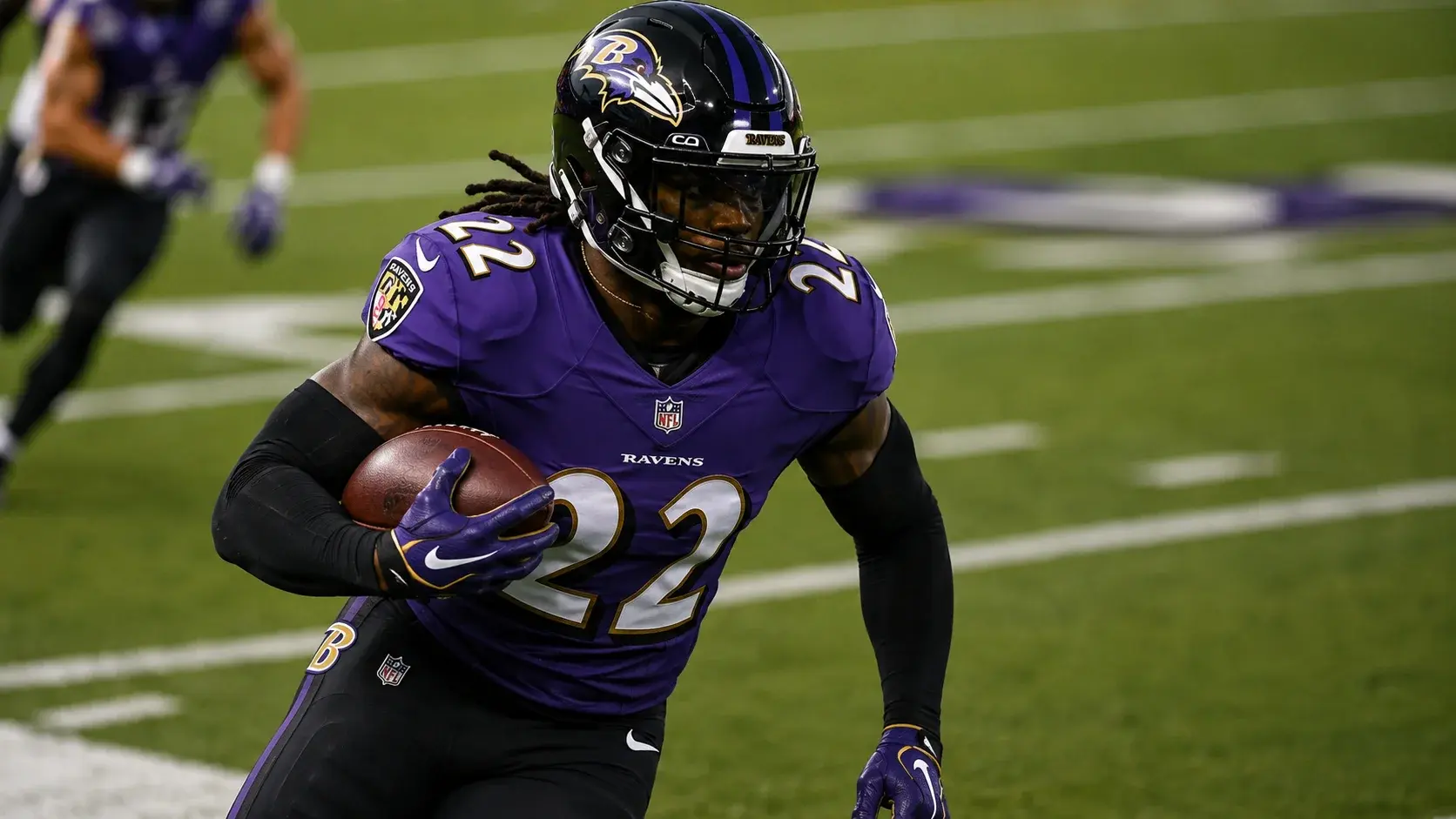
Rushing yardage props follow a similar logic but are more sensitive to game flow. A running back’s yardage line might be set at 72.5, but if his team falls behind by two touchdowns in the first half, they abandon the run and he finishes with 35 yards. Game script is the single biggest variable in rushing prop analysis, and it is the one that the bookmaker’s model handles least reliably because it depends on future events (the score) that have not happened yet.
Touchdown scorer props come in two flavours: anytime and first. Anytime touchdown scorer means the player scores at least one TD during the game. First touchdown scorer means they score the very first one. First-TD prices are much longer because the probability is lower and the variance is higher – even a player who scores regularly might not be the one to cross the line first. I gravitate toward anytime-TD markets because the larger sample of opportunities per game makes my analysis more relevant and the outcomes less random.
Reception props – over/under on the number of catches a player makes – are the newest entrant to mainstream UK NFL betting and the one most people underrate. A wide receiver’s reception total is tightly correlated with his target share, and target share is one of the most stable predictive stats in football. If a receiver has averaged eight targets per game across the first six weeks, and this week’s opponent gives up the fourth-most completions to wide receivers, the over on his reception line has a structural basis that goes beyond gut feeling. I build more of my NFL prop portfolio around receptions than any other category, and it has been my most consistent edge over the last three seasons.
Game Props: First Score Method, Margin of Victory and More
Game props zoom out from the individual and ask questions about the shape of the game itself. First scoring method – touchdown, field goal or safety – is one of the most popular. Margin of victory brackets (1-6 points, 7-12, 13-18, 19+) turn the final score into a range bet. Highest-scoring quarter, time of first score, total sacks in the game, total turnovers – these are all game props, and each one invites a different type of analysis.
First scoring method is one I come back to repeatedly because the pricing tends to be generous on field goals. The public overwhelmingly backs “touchdown” as the first score because touchdowns are exciting and memorable. But in practice, a significant percentage of NFL games open with field goals – long opening drives stall inside the red zone, early turnovers give the opposing team a short field, or both defences are fresh and aggressive in the first quarter. The field goal price at 3/1 or higher often represents genuine value, particularly in matchups between strong defences or in cold-weather late-season games where early offensive efficiency drops.
Margin of victory brackets require you to think about game flow rather than just the final number. A game you expect to be decided by a last-minute field goal (1-3 point margin) has a very different character from a game you expect to be a two-touchdown blowout. The pricing on these brackets varies widely between operators, and the overround across all brackets can be substantial. I use margin props sparingly, but when I do, I look for brackets where my projected margin distribution assigns significantly more probability than the implied odds suggest.
Defensive game props – total sacks, total turnovers, total punts – are the least popular and, in my experience, the least efficiently priced. Casual bettors focus on offensive skill players and scoring markets, which means the bookmaker gets less volume on defensive props and less market feedback to sharpen the price. That quiet corner of the market is where I have found some of my most reliable NFL prop edges.
Same-Game Parlays and Bet Builders for NFL
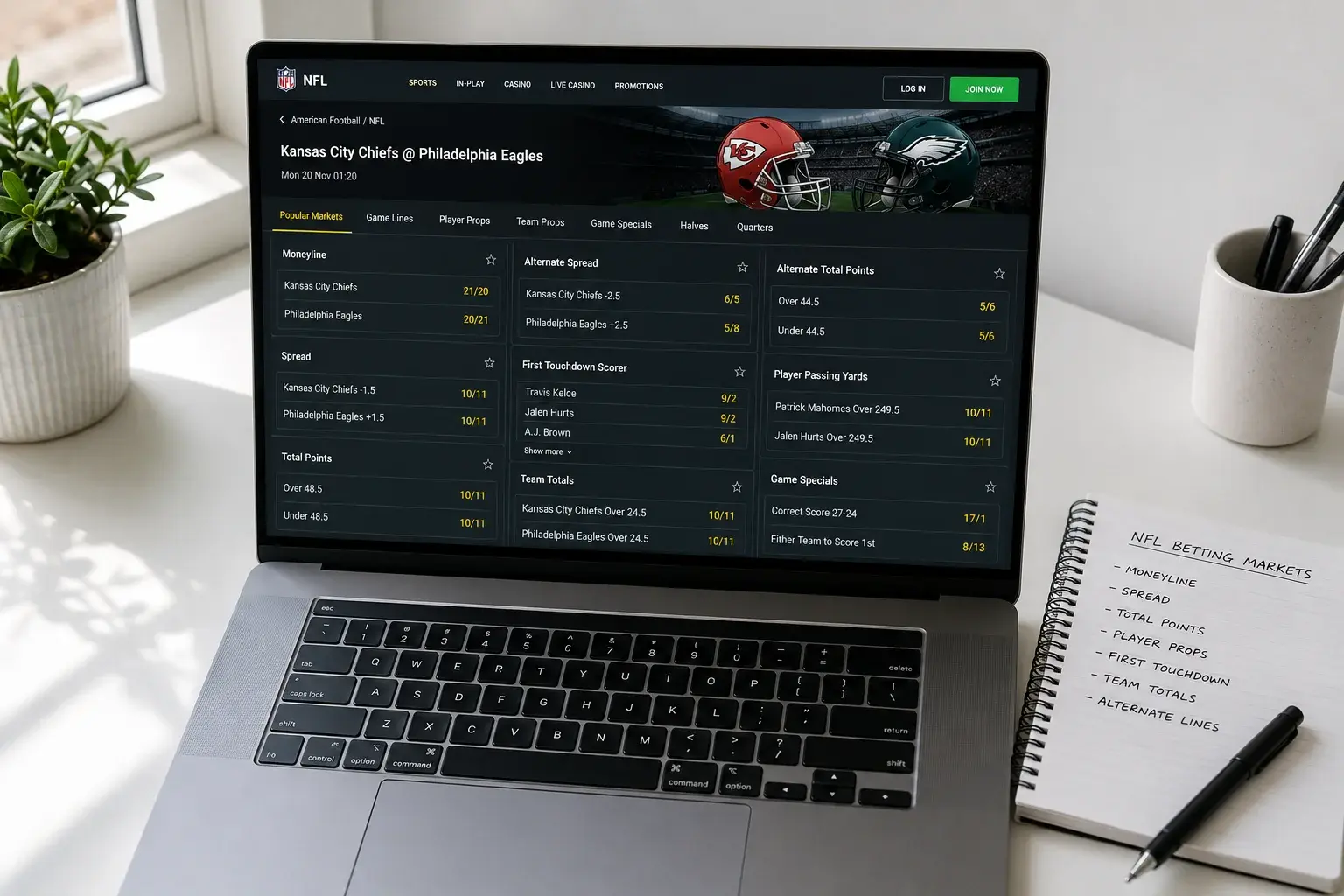
Same-game parlays – called bet builders at most UK bookmakers – let you combine multiple selections from a single game into one bet. Match result plus player yardage plus first touchdown scorer, all in one slip. The concept is wildly popular, the payouts look enormous, and the maths underneath should give every serious bettor pause.
The challenge is correlation. In a standard accumulator across different games, the outcomes are independent – one game’s result does not affect another’s. In a same-game parlay, the selections are correlated. If you back a team to win and their quarterback to throw for 300+ yards, those two outcomes are positively correlated: a team that wins is more likely to have had a productive passing game. The bookmaker’s model attempts to price that correlation, and it consistently does so in a way that benefits the house. The odds on a same-game parlay are almost always lower than the naive multiplication of individual leg odds, and the gap is the bookmaker’s correlation margin.
I am not opposed to same-game parlays, but I use them with open eyes. The best SGPs combine selections that are correlated in a direction the bookmaker’s model underweights. For example: backing a team to win, their running back to score a touchdown and the game total to go under. A low-scoring win with a rushing touchdown suggests a dominant ground-game performance, and those three outcomes are tightly linked in a way that standard pricing models sometimes undervalue. Lazy SGPs – stacking three popular players to score touchdowns and the favourite to win – are the bookmaker’s best friend because the correlation is priced perfectly and the overround is enormous.
For a step-by-step walkthrough of how to construct these bets mechanically on a UK platform, the NFL accumulator guide covers the broader mechanics that also apply to single-game builds.
How UK Bookmakers Price NFL Props
Prop pricing at UK bookmakers is not uniform, and the discrepancies are larger than most punters expect. I once found a four-point difference in a quarterback’s passing yardage line between two operators on the same game – 261.5 at one, 265.5 at the other. Four points might not sound like much, but on a market with a tight distribution around the mean, that gap changes the implied probability by several percentage points.
The variation exists because different operators use different pricing models, different data sources and different risk appetites for prop markets. Flutter Entertainment’s brands, with their enormous UK customer base, tend to set tighter prop lines because they receive more betting volume and therefore more market signal. Smaller operators sometimes set wider lines and adjust more slowly to new information, which can create short-lived pricing windows for attentive bettors. Entain’s portfolio, with projected 2025 revenue above two billion pounds, similarly invests heavily in pricing infrastructure, but the models are not identical across all their brands.
The timing of prop line release also matters. Some bookmakers post player props on Wednesday or Thursday, while others wait until Friday or even Saturday. Early-release props are priced on less information – the injury report may not be finalised, practice participation data may be incomplete. If you have access to early props and the informational advantage to exploit them, there is genuine value in acting before the market fully forms. By Saturday evening, when all operators have priced the full card, the discrepancies narrow and the edges shrink.
Researching Props: Stats, Snap Counts and Matchup Data
You cannot research NFL props effectively without getting into the weeds of individual matchup data, and that means going beyond the box score. The stat I look at first for any player prop is snap count share – what percentage of his team’s offensive plays was this player on the field for? A wide receiver who plays 95% of snaps has a fundamentally different opportunity profile from one who plays 60%. Volume of opportunity is the prerequisite for production, and snap count data is the most direct measure of volume.
Target share – the percentage of a team’s passing targets directed at a specific receiver – is the second filter. A receiver with a 28% target share is seeing the ball on nearly one in three passing plays, which provides a stable base for reception and yardage projections. Target share is stickier week-to-week than raw yardage or touchdowns, which makes it a more reliable predictive input.
Defensive matchup data adds the opponent dimension. How many rushing yards per game does this defence allow? How many completions to tight ends? How many sacks per game? These numbers are freely available on the NFL’s own statistical database and on several specialist analytics sites. The key is to use per-game averages adjusted for opponent quality rather than raw totals – a defence that has faced four elite quarterbacks and two backups will have inflated passing yards allowed, but that does not mean they are weak against the pass in neutral contexts.
Red-zone efficiency matters specifically for touchdown props. A running back who gets 60% of his team’s carries inside the 20-yard line has a structurally higher touchdown probability than one who splits red-zone work evenly with a backup. Red-zone touch share is one of the most predictive inputs for anytime-touchdown-scorer markets, and it is surprisingly stable across multi-week samples. I check it before every TD prop bet.
The research process sounds intensive, and it is – the first time. After a few weeks of building your player database, the weekly update takes 30-45 minutes because you are refining existing profiles rather than starting from scratch. That investment of time is the moat around prop betting: most casual punters will not do the work, which means the edges persist longer than they do in headline markets like the spread.
Why Prop Margins Are Wider – and When That Is Acceptable
Every prop market I have ever priced against the closing line carries a wider margin than the corresponding spread or moneyline on the same game. That is not a secret, and it is not an accident. Bookmakers charge more for props because the risk profile is different – the models are less precise, the data inputs are noisier, and the liquidity is lower. A typical NFL spread market carries an overround of 4-5%. A player yardage prop can sit at 8-12%. The question is not whether the margin exists, but whether the edge you find is large enough to overcome it.
Think of it this way. On a spread bet, you need to win roughly 52.4% of the time to break even at standard UK odds. On a prop with 10% overround, that break-even threshold climbs to around 55%. That is a meaningful difference over hundreds of bets. But here is the counterargument I keep coming back to: the spread market is priced by the sharpest bettors and most sophisticated models in the industry. Props, especially lower-profile ones, receive a fraction of that scrutiny. The wider margin is the cost of entry to a less efficient market, and inefficiency is where profit lives.
The trick is selectivity. I do not bet every prop that clears my research filter. I bet the ones where the gap between my estimated probability and the implied probability exceeds the overround by a comfortable margin – typically 5% or more. That discipline means I pass on 80% of the props I analyse, but the ones I take have structurally higher expected value than anything I could find in the heavily arbitraged spread market. Wider margins are acceptable when you have a genuine informational edge. They are unacceptable when you are guessing.
Special Prop Markets for NFL London Games
I was at Tottenham Hotspur Stadium for the 2023 Jacksonville-Buffalo game, and the prop markets that week were fascinating. London games create unique conditions that the standard US-centric prop models struggle to capture. Teams fly across five or six time zones, practice schedules are disrupted, and player routines – sleep, meals, preparation – are thrown off in ways that do not show up in seasonal averages.
UK bookmakers price London games more aggressively than their American counterparts because the local demand is enormous. Over 86,000 seats sell out within hours, and the casual betting interest around those fixtures is disproportionate to any regular-season game. That spike in recreational money pushes certain player props – particularly touchdown scorers and first scorer markets – into territory where the bookmaker is responding to demand rather than probability. The NFL staged five London games in 2024, and that number continues to grow, which means these opportunities recur annually during the autumn window.
The specific edges tend to cluster around travel effects. Teams travelling from the US West Coast to London cross eight time zones, and their offensive performance in the first half tends to dip relative to season averages. First-half yardage unders and lower-scoring first-quarter props have been disproportionately profitable in London games over the past five seasons. The sample size is small – about forty games total since the NFL started playing in London – but the directional pattern is consistent and grounded in physiology rather than noise. Jet lag affects reaction time, coordination and decision-making, all of which feed directly into player performance metrics.
Game props around total points also behave differently. The atmosphere at London games is electric but unusual – the crowd noise patterns differ from a typical NFL stadium, and teams often start conservatively. First-half unders in London fixtures hit at a rate well above 50%, and the market has been slow to adjust because the sample remains small enough for bookmakers to dismiss as variance. I treat London games as their own sub-market with distinct pricing characteristics, and I adjust my prop models accordingly every autumn.
Building a Prop Portfolio for Each NFL Sunday
The prop market rewards preparation. Start your weekly process on Tuesday when injury reports begin filtering through, build your player profiles by Thursday, and compare your projections against the bookmaker’s lines on Friday morning. By the time the Sunday slate kicks off – typically at 6pm UK time – you should have a shortlist of three to five props where your analysis disagrees meaningfully with the market price. That shortlist, refined over weeks and grounded in stable metrics like snap counts and target share, is worth more than a hundred hunches placed at kickoff. For the most competitive odds across all markets, always check our top UK NFL betting site before placing your wagers.