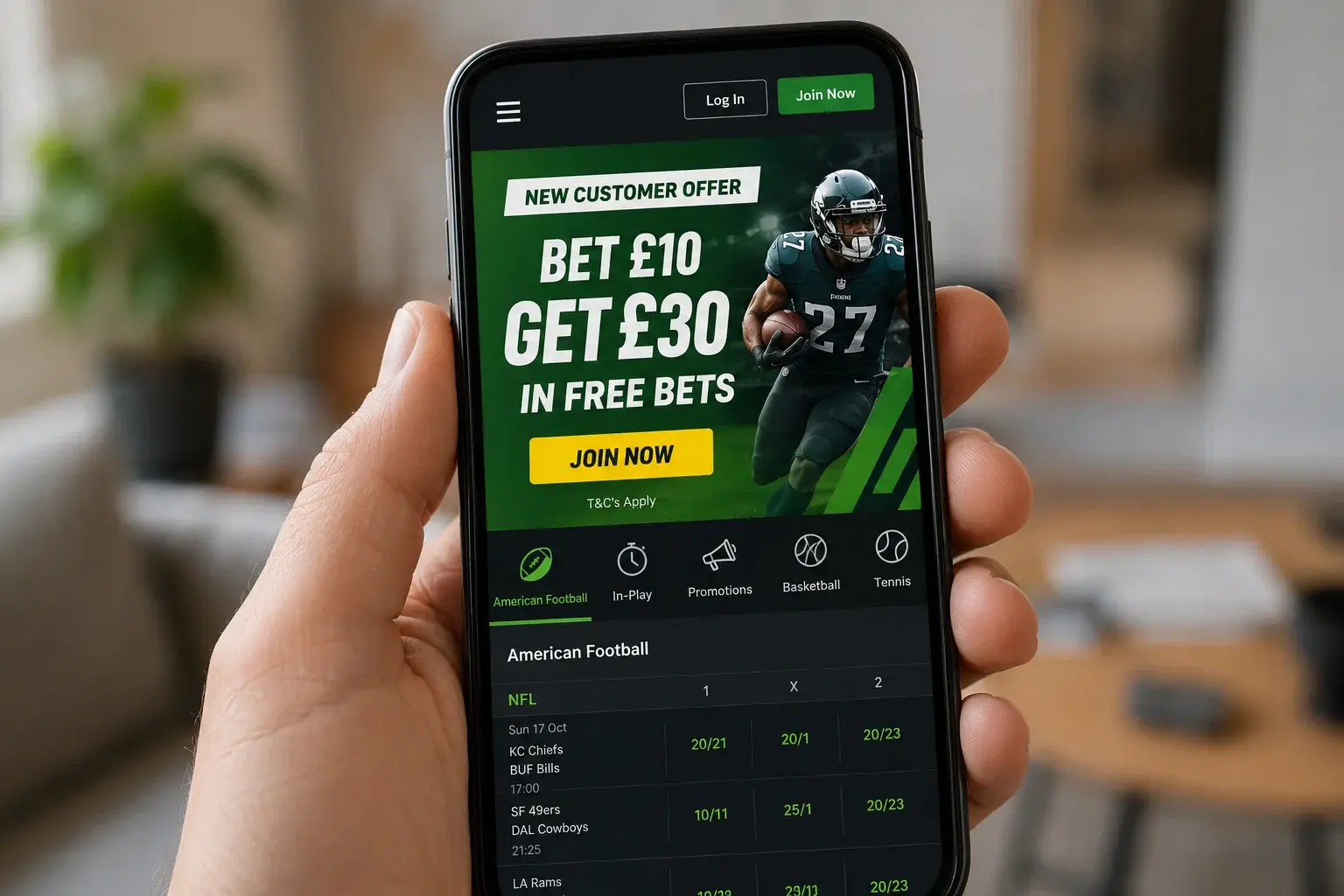
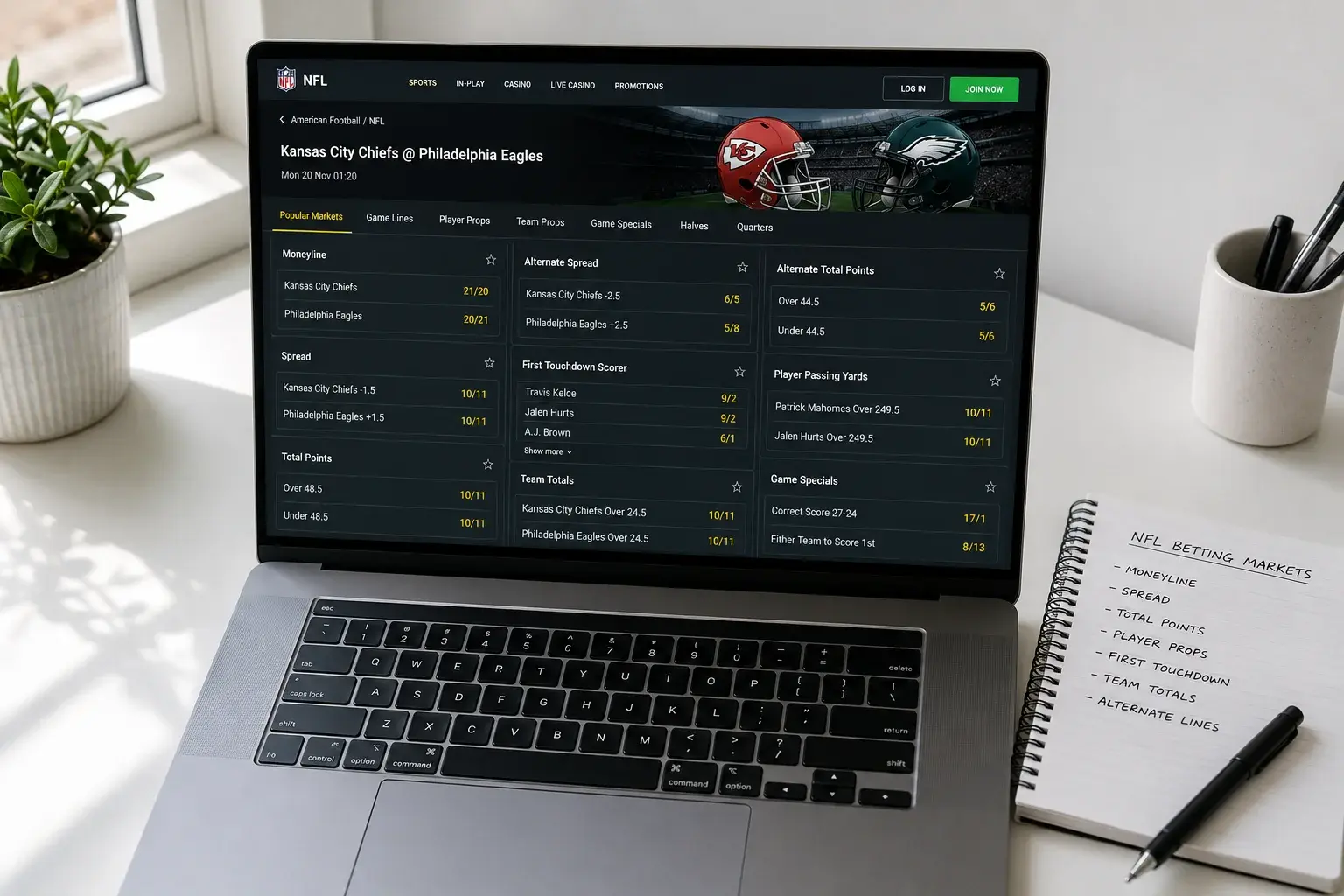
The first time I opened an NFL game page at a UK bookmaker and scrolled through the available markets, I counted over 120 options for a single regular-season fixture. That was five years ago. The number has grown since. In-play wagering now accounts for 62.35% of online sports betting revenue globally, and the rush to serve that demand has pushed operators to slice NFL games into every conceivable micro-market: who scores first, what the score will be at the end of the first quarter, whether the total punting yards will exceed a specific number.
For anyone trying to make sense of this catalogue, the volume can paralyse rather than empower. This article is the map. I will walk through every major market category you will encounter at UK bookmakers, explain what each one asks you to predict, and flag which ones offer the tightest margins and which ones exist primarily to extract money from casual bettors who are drawn to novelty over value.
Match-Result and Handicap Markets: Finding the Best Value
I always tell people to start where the bookmaker starts: the match-result market. At its core, this is a two-way bet — which team wins? UK bookmakers label this variously as “match result,” “moneyline,” or “match winner.” There is no draw option in the NFL (with negligible exceptions), so you are choosing between two outcomes with no third option eating into the probability.
Handicap markets — called point spreads in American terminology — adjust for the perceived gap between the teams. If a bookmaker sets a handicap of -6.5 for the favourite, that team needs to win by seven or more points for the bet to pay out. The underdog at +6.5 can lose by six or fewer and still cover. This market exists because the moneyline on heavy favourites offers slim returns, and the handicap creates a more balanced proposition that typically prices both sides close to even money.
UK bookmakers also offer European and Asian handicap variants, though these are less common for NFL than the standard American-style spread. The European handicap includes a draw outcome (the margin lands exactly on the number), while the Asian handicap uses split lines to eliminate the draw possibility. If you are coming from football betting, the Asian handicap will feel familiar; if you are new to handicaps entirely, the standard NFL spread is the place to begin.
Totals, Team Totals and Alternate Lines
Totals — the over/under market — ask a fundamentally different question from the match result: not who wins, but how much scoring will there be? The bookmaker sets a combined-points line (say 47.5), and you bet on whether the actual combined score will be higher or lower than that number.
Team totals narrow the focus to a single side’s scoring output. Instead of the combined 47.5, you might see “Team A over/under 24.5.” This is useful when you have a strong view on one offence’s performance but no opinion on the game’s overall trajectory. A dominant defence could suppress the opposing team’s total while having no effect on the team total for the side you are backing.
Alternate lines give you flexibility on both handicaps and totals. Instead of the bookmaker’s standard line of 47.5 at roughly even money, you can choose 44.5 at shorter odds (more likely to go over) or 51.5 at longer odds (less likely). The pricing adjusts to reflect the shifted probability. Alternate totals and alternate spreads are where experienced bettors often find value, because the wider the line moves from the market consensus, the more the bookmaker’s model can disagree with a bettor’s independent assessment.
Half-Time/Full-Time and Quarter Markets
NFL games are structured in four quarters with a halftime break, and bookmakers exploit every seam in that structure. Half-time/full-time bets ask you to predict who leads at halftime and who wins the game, creating a grid of four possible outcomes (home/home, home/away, away/home, away/away). The prices are longer than straight match-result bets because the prediction is more specific, and they can offer genuine value when you expect a game’s dynamic to shift between halves.
Quarter-by-quarter markets break things down further. You can bet on the outcome of each individual quarter — who wins the first quarter, what the total points in the third quarter will be, the exact score at the end of the second quarter. These markets are inherently higher-variance than full-game bets because the sample within each quarter is smaller: a single early touchdown can decide a first-quarter result, and the relationship between first-quarter performance and full-game outcome is loose enough to make independent analysis essential.
I use quarter markets sparingly and with specific intent. Third-quarter unders, for example, have historically been a profitable angle in certain NFL matchups because halftime adjustments frequently slow the pace of play coming out of the break. But “historically profitable” across a large sample and “profitable in Week 14 between these two specific teams” are very different claims. Quarter markets reward homework and punish guesswork more aggressively than any full-game bet.
Specials, Novelty Bets and Season-Long Markets
Every Super Bowl, the specials markets explode. Length of the national anthem, colour of the Gatorade shower, whether a specific celebrity will be shown in the crowd — these novelty bets generate headlines and social media engagement, but they are almost universally terrible value. The bookmaker sets the odds with enormous margins because the pricing has no statistical basis, and the entertainment value is the entire product.
Season-long markets are a different proposition entirely. Super Bowl winner, conference champions, division winners, MVP, regular-season win totals — these are futures bets that require your money to be locked in for weeks or months. The estimated legal wager volume on Super Bowl LX alone was $1.76 billion, a 27% year-on-year increase, and much of that money flows through futures markets that open the moment the previous season ends.
From a pricing standpoint, season-long markets carry the widest overrounds in the book. A Super Bowl winner market with 32 teams might have a combined implied probability north of 150%, meaning the bookmaker’s margin is roughly 50%. That is far wider than any match-day market. The trade-off is the potential for enormous returns — backing a 25/1 shot before the season and watching them win the title is the kind of bet that stories are made of. It is also the kind of bet that fails roughly 96% of the time, so size your stakes accordingly.
How Market Depth Varies by Bookmaker
Not every UK bookmaker treats NFL equally. The largest operators — Flutter Entertainment’s brands command projected 2025 revenue of £2.36 billion — tend to offer the deepest NFL market coverage: 100-plus options per game, full prop menus, bet builders, and in-play markets across every quarter. Mid-tier operators may cover core markets (moneyline, spread, totals, a handful of props) but skip the deeper player props and quarter-by-quarter lines.
Market depth also varies by fixture. A primetime Sunday Night Football game between two playoff contenders will carry more markets than a Week 4 matchup between two teams with losing records. Bookmakers allocate pricing resources based on expected handle, and a low-profile game simply does not justify the cost of pricing fifty player prop markets that nobody will bet on.
If market depth matters to you — and it should if you are serious about NFL betting — it is worth holding accounts at two or three operators so you can shop between them. The bookmaker that offers the best spread price may not be the one that prices the most exotic player prop. Having options gives you both better lines and broader coverage, which over a full season compounds into a meaningful edge.