
I spent my first NFL betting season confused about why the same game appeared three times in the handicap section of my bookmaker’s app — once as a “handicap,” once as an “Asian handicap,” and once as an “alternative handicap.” All three looked similar. None of the explanations I found online made the differences clear in a way that felt immediately useful. It took placing a few bets across all three formats, and watching how they settled differently on the same game, before I understood what each one was actually offering and when each made sense.
The confusion is understandable. UK bookmakers inherited the handicap terminology from football (soccer) betting and applied it to NFL markets, while American sportsbooks use “spread” terminology for what is essentially the same concept but with different settlement rules. The result is a situation where UK punters encounter multiple handicap formats on a single NFL game, each with subtly different mechanics that affect the risk profile and potential returns. Sports betting forms the largest segment of UK gambling revenue, accounting for 56.64% of market share in 2024, and handicap markets across all sports are a significant driver of that volume.
European Handicap Markets: High Returns at UK Sites
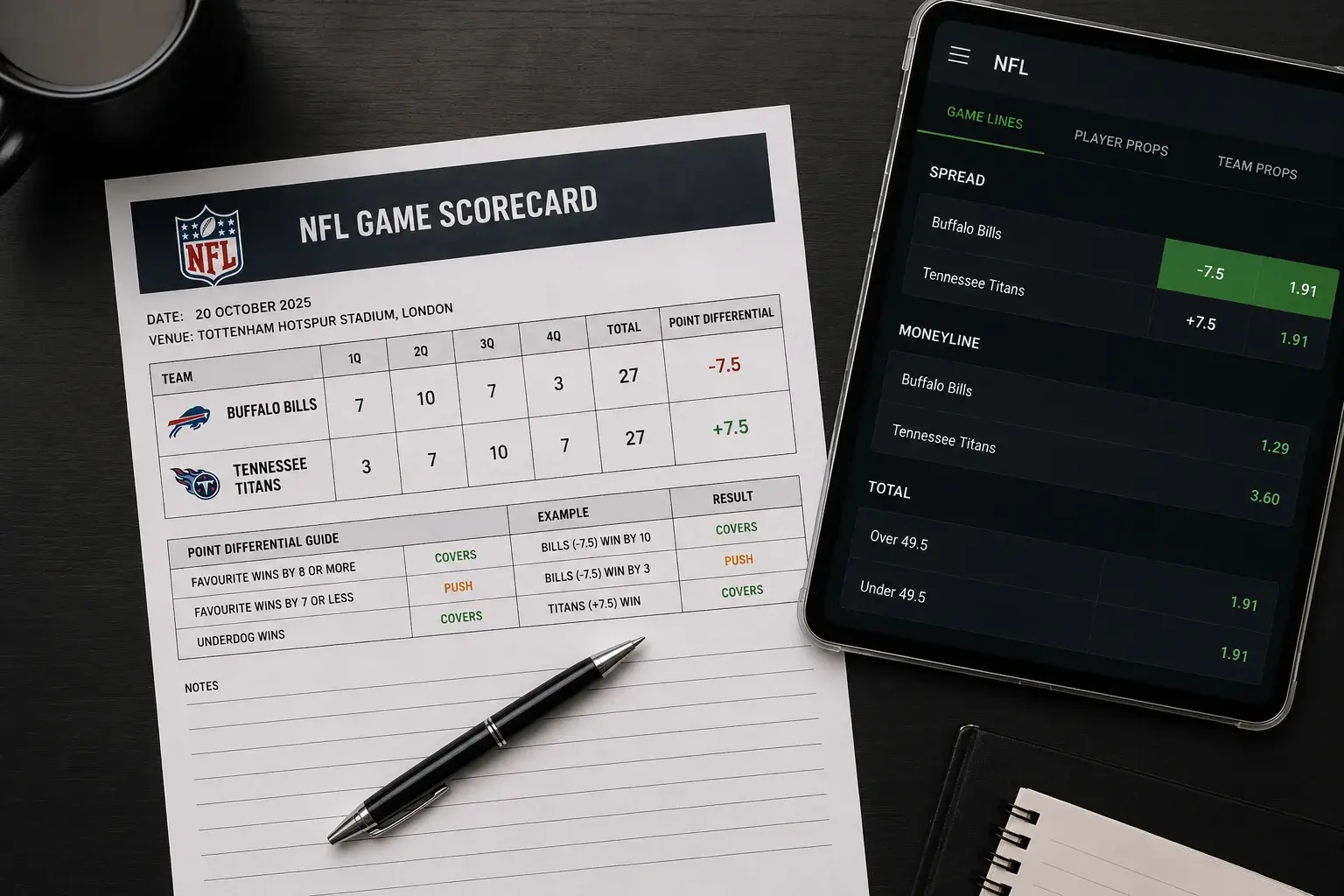
The European handicap is the format that most closely resembles traditional football betting. It has three possible outcomes: home win, away win, and tie. The handicap is applied to the final score, and if the adjusted result is level, the tie wins.
Suppose Team A is given a European handicap of -3 against Team B. If Team A wins the actual game by 4 or more points, the handicap bet on Team A wins. If Team A wins by exactly 3, the result after the handicap is a tie — and anyone who backed the tie at European handicap -3 wins. If Team A wins by fewer than 3, or loses, the handicap bet on Team B wins.
The key feature is that third outcome — the tie. In standard NFL spread betting (the American format), a push on the number returns your stake. In the European handicap, the tie is a separate betting outcome with its own odds, typically priced between 10/1 and 16/1 depending on how common that exact margin is. This means backing Team A at European handicap -3 is a different bet from backing Team A at -3 on the American spread, because the European version loses on the exact number while the American version pushes.
Why would anyone choose the European handicap? Two reasons. First, the odds on the home and away outcomes are typically slightly higher than the equivalent American spread because the bookmaker has removed the push scenario and redistributed that probability across the tie. Second, the tie itself is a legitimate betting option — if you believe a game will be decided by exactly 3 points (or whatever the handicap line is), the European format lets you bet on that directly at long odds.
In practice, I find the European handicap most useful for NFL games where I have a strong view on the margin of victory, not just who wins. If I think a game will be tight and decided by a field goal, the European handicap tie on -3 or +3 at 12/1 can offer better expected value than any other market on the board.
Asian Handicap: Eliminating the Draw With Split Lines
The Asian handicap eliminates the tie entirely, which is the defining difference from the European format. It achieves this through two mechanisms: half-point lines and split lines.
Half-point Asian handicaps work identically to American spreads with half-points. Team A at -3.5 means they need to win by 4 or more; there is no push because 3.5 is not a whole number. For UK punters familiar with American spread betting, this format requires no adjustment — it is the same thing under a different name.
Split-line Asian handicaps are where the format becomes genuinely distinct. A split line like -2.5, -3 means your stake is divided equally between two handicap bets: half on -2.5 and half on -3. If Team A wins by 4 or more, both halves win. If they win by exactly 3, the -2.5 half wins and the -3 half is a push (returned). If they win by 2 or fewer, both halves lose. The split line gives you partial protection on the key number — you get half your stake back if the margin lands exactly on 3, rather than losing the entire bet (European) or getting the full stake back (American push).
Split lines are particularly useful around the most common NFL margins of victory: 3 and 7 points. A split Asian handicap of -2.5, -3 lets you take a position close to 3 with built-in insurance. The odds reflect this reduced risk — they will be slightly lower than a straight -2.5 line — but the risk-adjusted return can be favourable for bettors who want exposure to a specific number without full downside if the game lands on it.
Alternative Handicap Lines and Their Pricing
Alternative handicap lines allow you to move the line away from the market consensus in exchange for different odds. If the standard handicap is -3, you can take -1.5 at shorter odds (more likely to cover but lower payout) or -6.5 at longer odds (less likely to cover but higher payout).
The pricing of alternative lines follows a predictable pattern tied to the probability distribution of NFL scoring margins. The global sports betting market is valued at an estimated $125.12 billion in 2026, with projections reaching $325.71 billion by 2035, and the sophistication of alternative-line pricing reflects the analytical investment that scale demands. Bookmakers use historical margin-of-victory data to model the probability of each possible final score difference, and alternative lines are priced off that distribution.
The practical value of alternative lines is in constructing bets with specific risk-reward profiles. If I believe a favourite will win comfortably but the standard spread of -6.5 feels like too much to give up, I might take -3.5 on the alternative line at shorter odds — I am still getting the team I want but with a cushion on the number. Conversely, if I think a heavy underdog will keep the game close but probably lose, I might take them at +10.5 on the alternative line rather than the market +6.5, accepting lower odds in exchange for a wider safety net.
Alternative handicaps also appear in bet builders and accumulators, where they can be combined with other selections to construct specific game scenarios. A builder combining “Team A alternative handicap -1.5” with “under 44.5 total points” tells a clear story: Team A wins a low-scoring game by at least a field goal.
UK Handicap vs American Spread: Naming and Pricing Differences
The fundamental concept is identical: adjust one team’s score by a fixed number and determine the winner. The differences are in terminology, settlement rules, and market presentation.
American spread betting at US sportsbooks uses the terms “spread,” “against the spread” (ATS), and “cover.” The standard vig is -110 on both sides, meaning you bet $110 to win $100. A push on a whole number returns the stake. UK bookmakers use “handicap” and price each side in fractional or decimal odds rather than the American -110 format. The vig is embedded in the odds rather than expressed as a standard juice figure.
Settlement on key numbers differs by format. The American spread pushes on whole numbers; the European handicap treats the whole number as a tie with separate odds; the Asian handicap uses split lines to partially protect your stake. These differences are most consequential on the numbers 3 and 7, which account for the highest concentration of NFL margins of victory. If you regularly bet around these numbers, choosing the right handicap format can measurably affect your long-term returns.
One subtle pricing difference: UK bookmakers sometimes offer slightly different lines than American sportsbooks on the same game, particularly for less popular matchups where the UK market is thinner. If you have access to American odds feeds (many are publicly available), comparing the UK handicap line to the US spread can occasionally reveal discrepancies worth exploiting — the same game priced at -3 in the UK and -2.5 in the US, for example.