
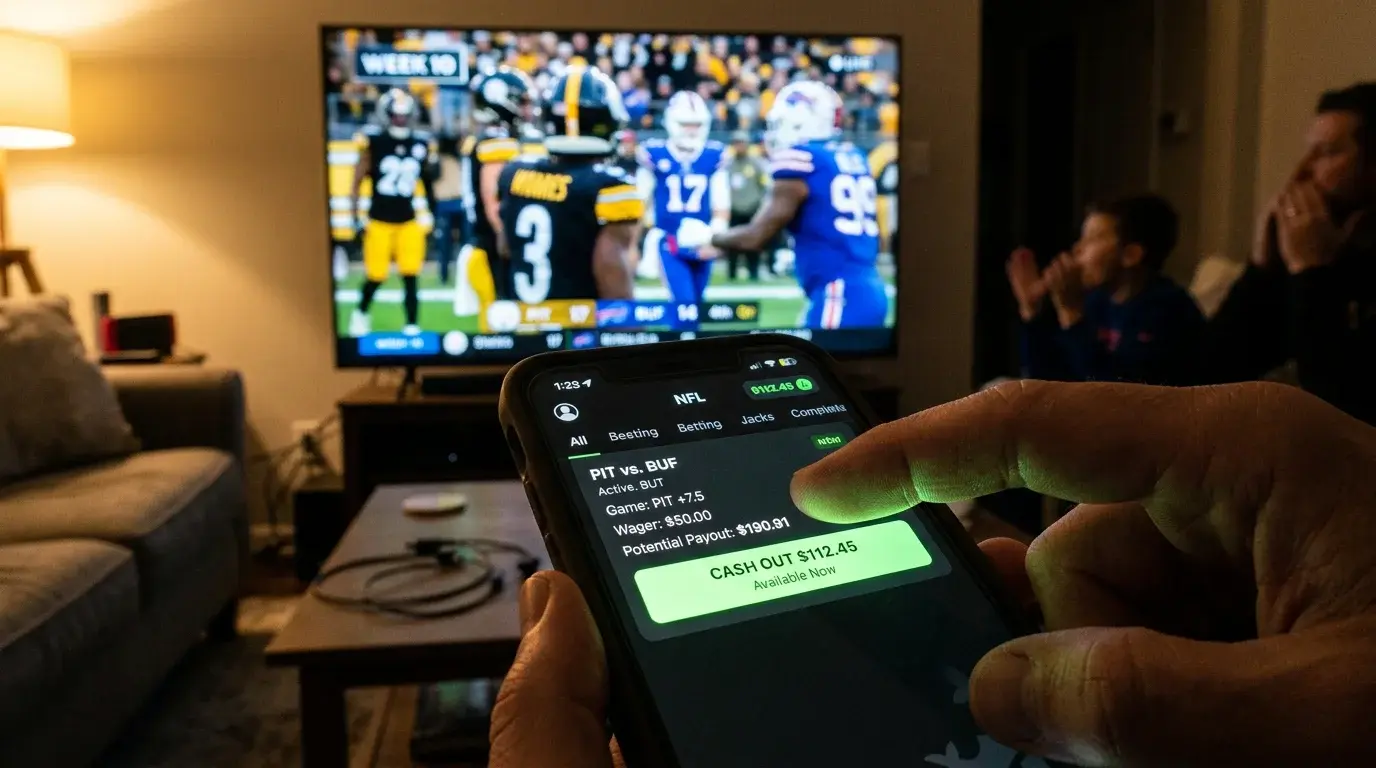
Fourth quarter, my accumulator is four legs in with one to go, and the final leg — Chiefs moneyline — is up by 14 with eight minutes left. The cash-out offer is sitting at £387 against a potential full payout of £520. I stared at the screen for a solid two minutes, did some rough maths in my head, and took the cash. The Chiefs won comfortably. I left £133 on the table. And I would make the same decision again.
Cash-out is the most emotionally loaded feature in modern sports betting. It feels like control. It feels like you are managing risk, locking in profit, making smart moves mid-game. But feelings and mathematics do not always agree, and the gap between them is where bookmakers make money on this feature. Live and in-play wagering now accounts for 62.35% of online sports betting revenue, and cash-out is one of the primary drivers — it keeps bettors engaged with their bets long after placement, refreshing the app to watch the offer fluctuate with every play.
Understanding exactly how cash-out works, what the bookmaker builds into the offer, and when it is genuinely rational to press the button separates disciplined bettors from those who are simply reacting to anxiety.
Full Cash-Out Features: Maximizing Returns at UK Bookies
I used to think of cash-out as a panic button. Bet going badly? Cash out and salvage something. Bet going well? Cash out and secure the profit. Both instincts are understandable, but they are driven by emotion, and the bookmaker is counting on that.
Full cash-out settles your bet before the event finishes. You receive a fixed amount and the bet is closed — whatever happens afterwards is irrelevant. The offer is recalculated continuously based on the current live odds of your selections. If you backed an NFL team at 3/1 and they are now 1/2 favourites at half-time, your cash-out value will be significantly higher than your original stake because the implied probability has shifted in your favour.
The mechanics are straightforward on the surface: the bookmaker calculates what your bet would pay out at current live odds, then subtracts their margin. That margin is the key. A cash-out offer is never the mathematically fair value of your position — it is the fair value minus a cut, typically somewhere between 3% and 8% depending on the operator and the market. You are paying for the convenience of early settlement, and the bookmaker is happy to let you exit because they have already priced their profit into the offer.
When your bet is losing, full cash-out works in the opposite direction. If you placed a £20 bet at 4/1 and the team is now trailing badly with odds drifted to 12/1, your cash-out offer might be £4 or £5. Taking it recovers a fraction of your stake. Leaving it open preserves the chance of a comeback, however slim. The rational question is whether the implied probability of your bet winning — given the current game state — justifies holding. If the bookmaker’s live odds say your team has a 7% chance and you assess it closer to 15% based on what you are watching, holding is correct. If you agree with the 7%, cashing out at any price above zero has positive expected value versus holding a losing position.
Partial and Auto Cash-Out Options
Full cash-out is binary — you are in or you are out. Partial cash-out, which most major UK bookmakers now offer on NFL markets, splits the difference. You cash out a portion of your bet and leave the rest running. If your potential payout is £500 and the cash-out offer is £350, you might take £200 in partial cash-out and leave £150’s worth of the bet active. If the bet wins, you collect the remaining proportion of the full payout plus the £200 already secured. If it loses, you keep the £200.
I use partial cash-out more than any other settlement option. It satisfies the psychological need to lock in something while keeping exposure to the full outcome. The maths works the same way as full cash-out — the bookmaker’s margin is baked into the partial offer too — but the flexibility lets you manage your bankroll without making an all-or-nothing decision.
Auto cash-out is the third variant, and the one most bettors underuse. You set a target cash-out value in advance — say, “cash out automatically if the offer reaches £400” — and the system executes it without you needing to be glued to your phone. This is particularly useful for NFL games that kick off at 1:00 AM UK time. Instead of setting an alarm to check your bet during the fourth quarter, you set an auto cash-out threshold and go to sleep. The discipline is built into the system rather than relying on your 2 AM decision-making, which is rarely at its sharpest.
One practical limitation: cash-out availability is not guaranteed. Bookmakers suspend cash-out during certain moments — when a play is in progress, during official reviews, or when the market is being repriced due to a major event like a turnover or score. NFL games have frequent stoppages, so the cash-out window tends to be available more often than in football, but do not assume you can always press the button at the exact moment you want to.
The Mathematics Behind Cash-Out Offers
Strip away the user interface and the green button, and cash-out is a second bet. You are effectively placing a new wager against your original position, and the bookmaker is acting as the counterparty on both sides. Understanding this reframing changes how you evaluate the offer.
Take a concrete example. You bet £10 on an NFL team at 5/1 (6.00 decimal). Potential return: £60. At half-time, your team leads and the live odds have shortened to 2/1 (3.00 decimal). The fair cash-out value — with no margin — would be your original stake multiplied by the ratio of original odds to current odds: £10 x (6.00 / 3.00) = £20. But the bookmaker does not offer £20. They offer, say, £18.50. That £1.50 difference is their margin on the cash-out transaction. In percentage terms, you are paying about 7.5% for the privilege of early settlement.
The global sports betting market is valued at $125.12 billion in 2026 and projected to reach $325.71 billion by 2035, and cash-out features are a meaningful contributor to that growth because they generate additional margin on bets that have already been placed. Every cash-out is a new revenue event for the bookmaker, layered on top of the original vig from the initial bet.
The margin is not fixed. It fluctuates based on market liquidity, time remaining in the game, and the volatility of the current situation. Early in the first quarter, when the outcome is still highly uncertain, cash-out margins tend to be wider. In the closing minutes of a lopsided game, when the outcome is nearly certain, margins narrow because the bookmaker’s risk is minimal. This is worth knowing because it means the “cost” of cashing out is not constant — the same bet at different moments carries different cash-out premiums.
For accumulators, the maths compounds. Each leg that has already won reduces the uncertainty, which should increase the cash-out offer. But each remaining unsettled leg introduces its own margin. A five-leg acca with three legs won and two remaining has two layers of margin baked into the cash-out calculation. The more legs in your accumulator, the more the bookmaker takes in aggregate margin on the cash-out offer relative to the theoretical fair value.
Scenarios Where Cashing Out Is and Is Not Rational
My personal rule is simple: I cash out when the information has changed, not when my emotions have changed. If I placed a bet based on a specific analysis and nothing in that analysis has been invalidated, I hold. If new information — an injury, a tactical shift, a weather change — materially alters the probability, I reassess.
Cashing out makes rational sense when your updated assessment of the probability is lower than what the cash-out offer implies. If the bookmaker’s live odds give your bet a 60% chance of winning and your own analysis says it is closer to 45% after watching the first half, the cash-out offer is priced more favourably than your view of reality. Take it. Conversely, if you believe the true probability is higher than the implied odds, holding delivers better expected value over the long run, even though individual bets will sometimes lose.
Bankroll management creates legitimate cash-out situations that pure expected-value calculations miss. If winning a bet would represent a significant portion of your total bankroll, cashing out at a slightly suboptimal price can be rational from a risk-management perspective. Variance reduction has real value, especially for recreational bettors whose bankrolls are limited. Losing a bet that would have paid three months’ betting budget hurts more than the theoretical expected-value loss from cashing out early.
Where cashing out is almost never rational: panic-selling a bet because the other team scored early. NFL games are four quarters long, and early deficits are overcome routinely. If your pre-game analysis was sound and the underlying conditions have not changed, a 7-0 deficit in the first quarter does not warrant cashing out at a fraction of your stake. The same logic applies to chasing cash-out offers upward — refreshing the screen hoping the number ticks up by another £5 before pressing the button. That is not analysis. That is gambling within gambling. Understanding live NFL betting dynamics helps here, because it trains you to evaluate shifting probabilities in real time rather than reacting to scoreboard anxiety.
One final scenario worth flagging: cashing out to reinvest. Some bettors cash out a winning position and immediately place a new bet on a different market in the same game. This can be valid if the new bet offers better expected value than holding the original position. But it can also be a rationalisation for overtrading. If you find yourself cashing out and redeploying multiple times per game, you are paying the bookmaker’s margin on every transaction. Each cash-out costs you 3-8%, and doing it three times in a game means you have paid up to 24% in cumulative margins. At that point, the house edge is eating your edge alive.