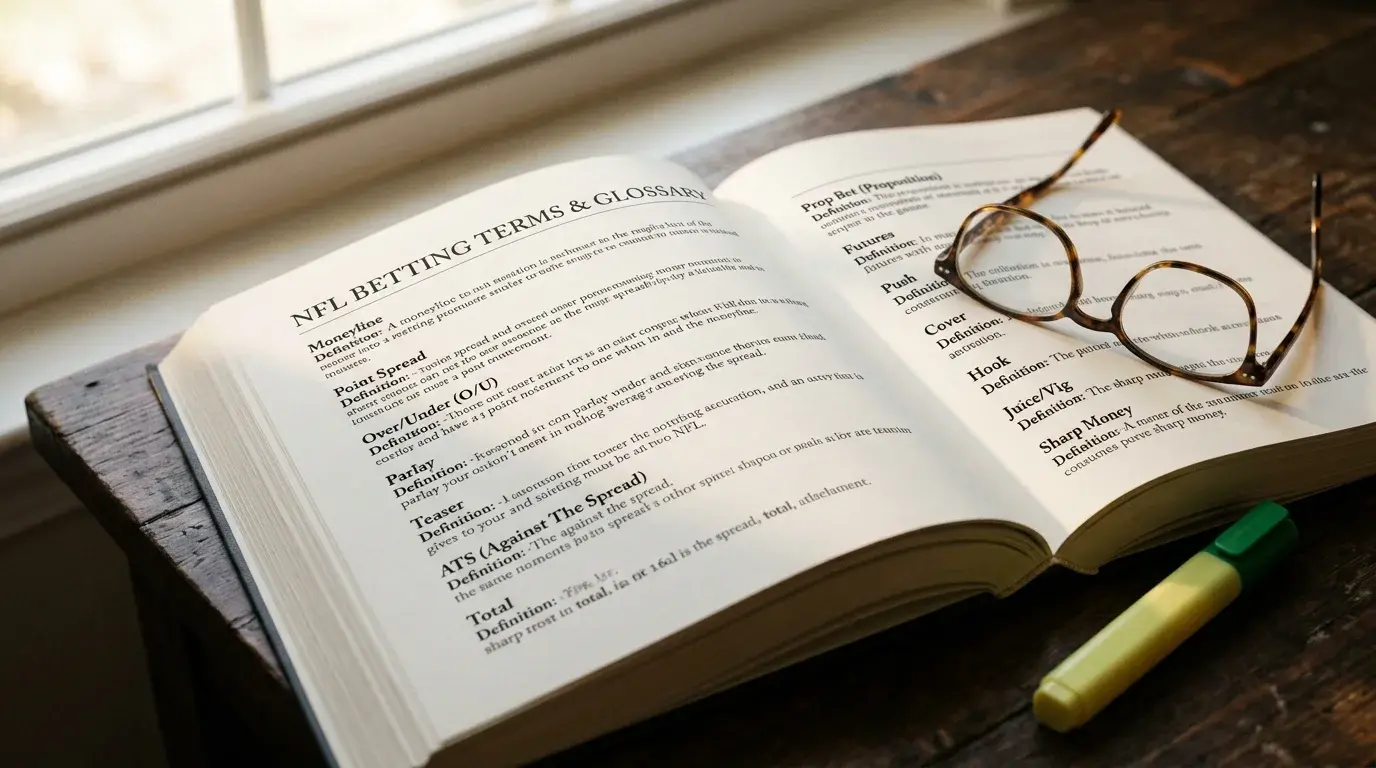
When I started betting on NFL from the UK, I kept running into terms that seemed designed to confuse anyone who had not grown up with American sports. “Covering the spread” sounded like a farming technique. “Juice” belonged in a kitchen. “Chalk” was something I used at school. The problem was not intelligence — it was vocabulary. NFL betting has its own language, drawn partly from American sports culture, partly from UK bookmaking tradition, and partly from a global betting industry that uses different terms for the same concepts depending on which side of the Atlantic you are standing on.
The UK is home to approximately 14.3 million NFL fans, and a growing proportion of them are betting on the sport through UKGC-licensed bookmakers. But the analytical content, podcasts, and social-media commentary that inform NFL betting decisions are predominantly American, which means UK bettors need to be fluent in both vocabularies. This glossary covers the essential terms in both UK and US usage, organised alphabetically so you can find what you need quickly.
A-F Betting Terms: From Accumulator to Futures Markets
Accumulator (Acca): A single bet combining multiple selections across different games. All legs must win for the bet to pay. Known as a “parlay” in the US. The odds are multiplied together, minus any correlation adjustments for same-game combinations.
Against the Spread (ATS): A team’s record when the point spread is applied. A team that is 8-4 ATS has covered the spread in 8 of 12 games. ATS records are a common metric in US NFL betting analysis.
Bankroll: The total amount of money you have set aside for betting. Separate from your daily finances. Bankroll management involves determining what percentage of this total to risk on each bet.
Bet Builder: A feature at UK bookmakers that lets you combine multiple selections from the same game into one bet. Equivalent to a same-game parlay (SGP) at US sportsbooks. The bookmaker applies correlation adjustments to the combined odds.
Chalk: US slang for the favourite. “Taking the chalk” means betting on the favoured team. The term originates from the days when odds were written in chalk on blackboards.
Cover: To win by more than the point spread. If a team is -3 and wins by 4 or more, they have “covered the spread.” If the underdog is +3 and loses by fewer than 3 (or wins outright), the underdog has covered.
Dead Heat: A tied outcome on a specific market, such as two players tying for most rushing yards. Dead-heat rules typically split the payout proportionally.
Each Way: A UK bet type that places two stakes — one on the selection to win and one on the selection to “place” (finish within a specified number of positions). Available on NFL futures at some UK bookmakers, where “place” might mean reaching the conference championship.
Edge: The bettor’s advantage over the bookmaker on a specific bet. If you estimate a team’s true probability of covering at 55% and the odds imply 50%, you have a 5% edge.
Expected Value (EV): The average profit or loss per bet if the same bet were placed many times. A positive EV (+EV) bet is profitable over the long run; a negative EV bet loses money over time.
Favourite: The team expected to win. Indicated by a minus sign on the spread (e.g. -3) or shorter odds on the moneyline.
Fractional Odds: The default UK odds format (e.g. 5/1, 11/8). The first number is the potential profit; the second is the stake. 5/1 means £5 profit for every £1 staked.
Futures: Bets on outcomes decided at the end of the season or a specific event, such as Super Bowl winner, MVP, or season win totals. Known as “ante-post” in traditional UK racing terminology.
G-O: Gridiron to Over/Under
Gridiron: Informal name for American football, derived from the grid-like yard-line markings on the field. Used more in the UK than in the US.
Handicap: The UK term for what Americans call the “spread.” A points adjustment applied to one team to level the betting proposition. Comes in European (three outcomes including tie), Asian (no tie), and alternative (adjustable) formats.
Handle: The total amount of money wagered on a specific game, market, or time period. A high handle indicates heavy betting volume.
Hook: US slang for a half-point on the spread. “Getting the hook” means your spread includes a half-point (e.g. -3.5 instead of -3), which eliminates the possibility of a push.
Implied Probability: The probability of an outcome as suggested by the odds, after removing the bookmaker’s margin. Fractional odds of 3/1 imply a probability of 25%.
In-Play (Live Betting): Bets placed after a game has started, with odds updating in real time based on the score and game situation.
Juice: US term for the bookmaker’s commission on a bet. Also called “vig” or “vigorish.” In the UK, this is embedded in the odds rather than expressed as a separate charge.
Key Numbers: The most common margins of victory in NFL games. The two most important are 3 (a field goal) and 7 (a touchdown with extra point). Spreads that cross these numbers are considered more significant.
Line: The current odds or spread on a game. “The line is -3” means the favourite is giving 3 points.
Lock: Slang for a bet considered a certain winner. In practice, no bet is a lock — the term is used loosely and often incorrectly.
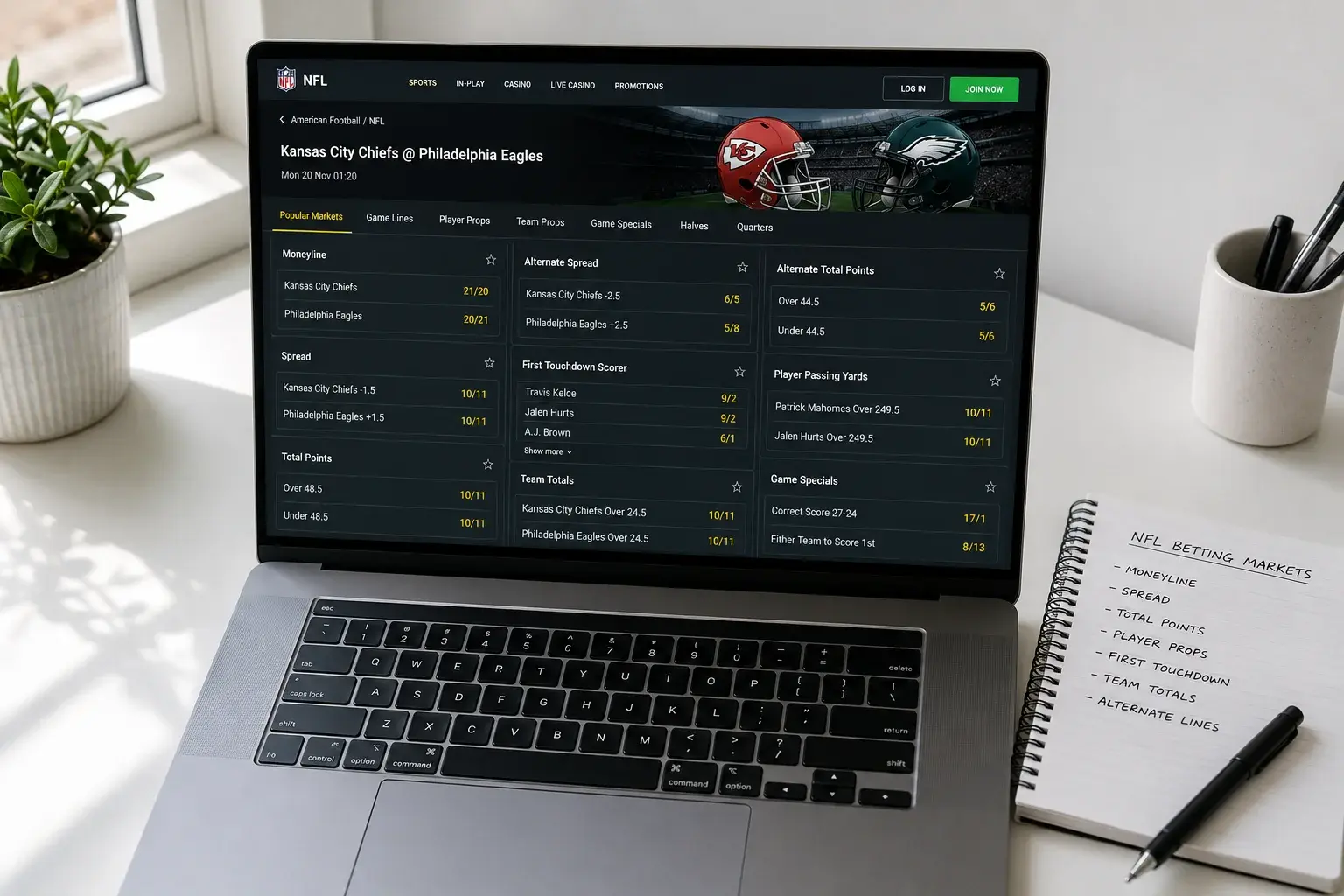
Moneyline: A bet on which team will win outright, with no spread applied. The odds reflect the relative probability of each team winning.
Odds-On: Odds shorter than even money (e.g. 4/7, 1/3). The potential profit is less than the stake. Common on heavy favourites.
Over/Under (Totals): A bet on whether the combined score of both teams will be above or below a number set by the bookmaker.
Overround: The total implied probability of all outcomes in a market, which exceeds 100% due to the bookmaker’s margin. A market with a 105% overround has a 5% margin.
P-Z: Parlay to Vig
Parlay: The US term for an accumulator. A bet combining multiple selections where all must win for the bet to pay.
Pick’em (PK): A game with no point spread — the line is set at 0, meaning neither team is favoured. Both teams are priced equally on the spread.
Player Prop: A bet on an individual player’s performance in a specific statistical category, such as passing yards, rushing touchdowns, or receptions.
Point Spread: The US term for the handicap. The number of points by which the favourite is expected to win. A -3 spread means the favourite must win by more than 3 to cover.
Prop Bet (Proposition Bet): Any bet that is not directly tied to the final score or result of the game. Includes player props, game props (first team to score, total sacks) and novelty props (Super Bowl coin toss).
Push: A bet that results in a tie against the spread. The stake is returned. A -3 spread where the favourite wins by exactly 3 is a push.
Same-Game Parlay (SGP): A parlay combining multiple selections from the same game. Called a “bet builder” at most UK bookmakers. The bookmaker adjusts odds for correlated outcomes.
Sharp: A knowledgeable, professional-level bettor whose wagers are respected by bookmakers and can move lines. “Sharp money” is the volume wagered by these bettors.
Square: The opposite of sharp — a recreational or casual bettor whose wagers are driven more by sentiment than analysis.
Stake: The amount of money placed on a bet.
Steam: Rapid, significant line movement caused by heavy volume on one side, often driven by sharp bettors.
Teaser: A US bet type that allows the bettor to adjust the spread in their favour on two or more games in exchange for lower odds. Less common at UK bookmakers but available at some operators.
Tout: A person who sells betting picks or tips, often with exaggerated claims of success. Treat with scepticism.
Underdog: The team expected to lose. Indicated by a plus sign on the spread (e.g. +3) or longer odds on the moneyline.
Unit: A standardised bet size, typically 1-2% of your total bankroll. Using units rather than fixed pound amounts helps maintain consistent risk management as your bankroll grows or shrinks.
Value: A bet where the odds offered are better than the true probability of the outcome. Finding value is the fundamental goal of analytical betting.
Vig (Vigorish): The bookmaker’s built-in commission on a bet. The reason that winning 50% of even-money bets produces a loss rather than break-even. Also called “juice” in the US and the “overround” in UK terminology.
UK and US Terms for the Same Thing
One of the most common sources of confusion for UK NFL bettors is encountering American content that uses different words for concepts they already understand. The UK accounts for approximately 3% of the global NFL audience by web-traffic volume, but the overwhelming majority of NFL betting content is produced for an American audience. Here are the most important translations.
What UK bookmakers call a “handicap,” US sportsbooks call a “spread” or “point spread.” What the UK calls an “accumulator” or “acca,” the US calls a “parlay.” The UK “bet builder” is the US “same-game parlay.” The UK “each way” has no direct US equivalent. The US “vig” or “juice” corresponds to the UK “overround” or simply “the margin.” “Punter” is UK slang for a bettor; the US equivalent is simply “bettor” or “player.” Understanding these transatlantic differences is essential if you consume American NFL analysis and apply it to your UK betting.
The terminology gap narrows each year as the UK NFL fan base grows and cross-cultural content proliferates, but it is still wide enough to cause real confusion in moments that matter — particularly when an American podcast host says “take the Chiefs minus the hook” and you need to translate that into a -3.5 handicap bet at your UK bookmaker within the next 30 seconds.