
I have lost count of the number of bets I have missed because an app took too long to load the NFL in-play market. One Sunday, with a game about to reach a pivotal fourth-quarter drive, I tapped through to the live markets and watched a loading spinner for 15 seconds before the odds refreshed — by which point the line had already moved past the price I wanted. That experience crystallised what I now consider the single most important factor in choosing an NFL betting app: speed under pressure.
The welcome bonus gets the headlines, and it is usually the reason people download a particular app in the first place. But the welcome bonus is a one-time event. The app’s speed, interface, market depth and notification system are things you live with for every bet, every game, every week of the season. An estimated 95% of online gambling in the UK takes place from home, and within that figure, the 18-24 age group leads mobile usage at 76%. For NFL betting, where UK kick-off times mean you are often betting from the sofa late on a Sunday evening, the mobile experience is effectively the only experience that matters.
App Selection Criteria: Mobile Markets and Streaming
After years of testing different apps across multiple NFL seasons, I have settled on four criteria that I weigh above everything else. Speed is first: how quickly does the app load markets, process bet placement, and update live odds? An app that lags by even a few seconds during an NFL drive can cost you a price point. Second is NFL market depth — not total market depth across all sports, but specifically how many NFL markets the app carries per game and whether those markets include the player props and bet-builder options that make NFL betting interesting.
Third is the alert and notification system. A good NFL betting app should allow you to set push notifications for specific events: line movements on games you are tracking, kickoff reminders, and settlement confirmations. The best implementations let you customise which alerts you receive rather than blasting you with promotional notifications disguised as useful information. I turn off promotional push notifications on every app I use — they clutter the experience and are designed to drive impulsive betting, which is the opposite of a disciplined approach.
Fourth is streaming integration. If an app offers live NFL streaming alongside its betting interface, the value is significant — you can watch the game and place in-play bets without switching between apps. Not all UK operators offer NFL streaming, and those that do often require a funded account or a recently placed bet to access the stream. I will cover the streaming landscape in more detail below, but at the selection stage, ask whether the app streams the NFL games you care about before committing to it as your primary platform.
In-Play Bet Placement Speed on Mobile
NFL in-play betting is fundamentally different from football in-play betting because of the sport’s stop-start structure. Every play has a defined beginning and end, and between plays there is a window of 25 to 40 seconds during which the next play’s odds are available. The bookmaker updates lines during those windows based on the result of the previous play, and if your app is slow, you are placing bets on stale odds that the server may reject.
Live and in-play wagering accounts for 62.35% of online sports betting revenue, and mobile is the primary channel for that activity. The best NFL betting apps process in-play bet placements within two to three seconds. Slower apps take five to eight seconds, and at the lower end some take even longer during high-traffic moments like Red Zone scoring drives or primetime games.
One indicator of in-play speed that most bettors overlook: the “bet accepted at different odds” notification. If you are regularly seeing your in-play bets accepted at a different price from the one displayed when you tapped the button, the app’s odds feed is lagging behind the server. Some apps offer a “accept any odds movement” toggle that speeds up placement at the cost of price certainty. I leave this toggle off — I want to know what price I am getting — but if speed is your absolute priority and you are comfortable with small fluctuations, it can reduce the frustration of rejected bets.
NFL Market Depth: How Apps Differ
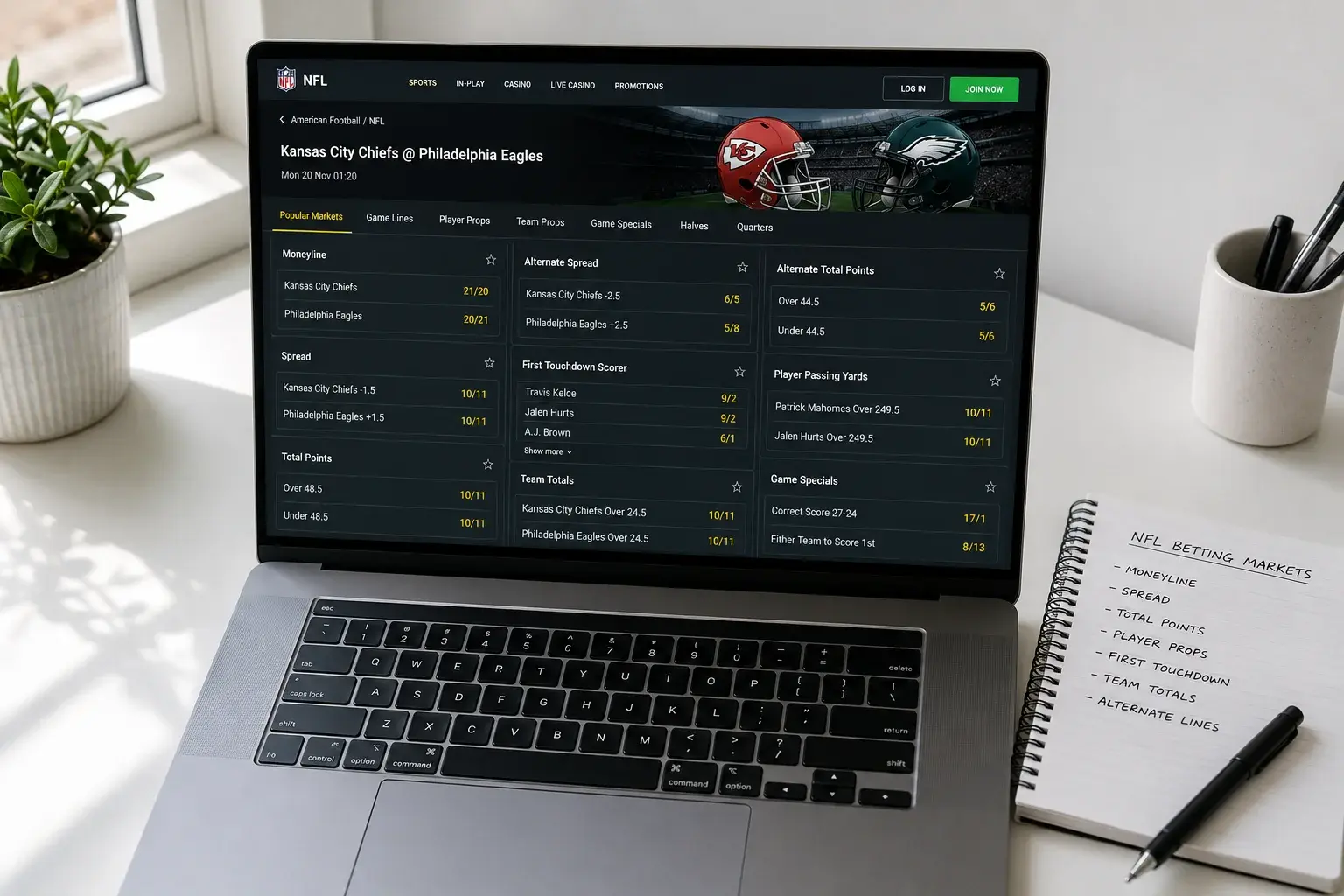
Not every UK betting app treats NFL with the same seriousness. Some operators view American football as a secondary sport and offer a basic market set: moneyline, spread, total, and a handful of player props. Others — particularly the larger operators — invest in dedicated NFL trading teams that price 100 or more markets per game, including detailed player props, quarter-by-quarter markets, drive outcomes, and the full range of NFL betting markets that experienced punters expect.
The difference becomes most apparent in the bet-builder feature. An app with deep NFL data allows you to combine 10 or more selections from a single game. An app with shallow NFL coverage might cap you at four or five selections, or exclude player props from the builder entirely. If bet builders are a core part of your NFL betting approach, market depth is non-negotiable.
Flutter Entertainment, with projected 2025 revenue of £2.36 billion, and Entain, at £2.04 billion, operate the UK’s largest platforms. Both invest heavily in NFL-specific content: pre-game analysis, live stats dashboards, and proprietary odds models that draw on partnerships with data providers. Smaller operators often rely on third-party odds feeds, which means their NFL pricing is less nuanced and their market availability is less consistent.
A practical test I run on any new app: check the market count for a mid-afternoon Sunday NFL game (not a primetime or playoff fixture). If the app carries fewer than 50 markets for a standard regular-season game, its NFL coverage is likely too shallow for anything beyond basic match-result betting.
Using Push Notifications for NFL Line Movements
Line-movement alerts are the most underused feature in NFL betting apps. Most serious bettors check odds manually — opening the app, navigating to the game, comparing the current line to what they saw earlier. This works, but it is reactive. A push notification that tells you the moment a line moves through a key number (for instance, a spread crossing from -2.5 to -3, or a total dropping from 45 to 44.5) turns your phone into a passive monitoring tool that does the watching for you.
Not every app offers line-movement notifications. Those that do typically require you to “favourite” or “watch” specific games, after which the app sends alerts when the odds on your watched markets change by a defined threshold. The threshold varies — some apps alert on any movement, others only on movements of 0.5 points or more.
I configure line-movement alerts on Tuesday or Wednesday each week, once I have identified the games I am interested in. By Thursday, the early-week line movement from sharp bettors has usually settled, and any further movement is driven by injury news or public money. A push alert telling me that a total has dropped by a full point on Friday afternoon — usually because of a weather forecast or a late injury report — gives me the information I need to act before the market adjusts further. The alternative is discovering the movement on Sunday morning, by which time the value has already been absorbed.