
Every NFL bet I have ever placed started the same way: who do I think wins this game? That instinct — the simplest question in sport — is exactly what the moneyline captures. No handicaps, no point adjustments, no combined scores. Pick the team that walks off the field with the W, and if you are right, you get paid. If you are wrong, you do not.
I have been analysing NFL lines at UK bookmakers for over a decade, and the moneyline remains the market where beginners feel most at home and where experienced punters keep finding spots that the spread and totals miss. Sports betting commands the largest revenue share in the UK gambling market — 56.64% in 2024 — and the moneyline is the gateway through which most of that action enters the system. It is deceptively simple, because the pricing tells a much richer story than “this team is the favourite.”
Moneyline Pricing: Securing Top Odds at UK Bookmakers
I once spent a Thursday evening explaining moneyline pricing to a friend using nothing but a pair of dice and a pint glass. It worked better than any spreadsheet. Here is the logic: the bookmaker assesses the probability of each team winning, converts that into odds, and then adds a margin — the overround — to guarantee itself a profit regardless of the outcome.
At a UK bookmaker, NFL moneylines display in fractional odds by default. A strong favourite might be priced at 2/7, meaning you stake £7 to win £2 profit. The underdog in the same game could sit at 5/2, where a £2 stake returns £5 profit. Switch your display to decimal and those become 1.29 and 3.50 respectively. The numbers change, the maths does not.
What determines those prices? Two things primarily: the market’s consensus on each team’s chance of winning, and the volume of money flowing in from bettors. The UK’s two largest operators — Flutter Entertainment with projected 2025 revenue of £2.36 billion and Entain at £2.04 billion — move enormous volumes across NFL markets, and their moneyline prices set the tone that smaller bookmakers track. When you see a moneyline shift between Tuesday and Sunday, it is usually because sharp bettors have loaded one side, forcing the bookmaker to rebalance exposure.
One nuance that catches UK punters: NFL moneylines do not include a draw option. American football games cannot end in a tie during the regular season (since the 2022 rule change that adjusted overtime procedures) except in extraordinarily rare circumstances, and playoff games always produce a winner. So unlike football match-result markets where you have three outcomes, the NFL moneyline is a straight two-way market. That binary structure is one reason the odds tend to be tighter than you might expect.
Favourites vs Underdogs: Calculating Your Return
Let me lay out a concrete example, because this is where the moneyline either clicks or confuses.
Take a hypothetical Week 8 matchup. The home team is favoured at 4/9 (decimal 1.44). The away team is the underdog at 7/4 (decimal 2.75). You have £20 to allocate.
Backing the favourite at 4/9: your £20 stake returns £8.89 profit plus your £20 back, for a total of £28.89. You need to risk £20 to make less than £9. The implied probability baked into those odds is roughly 69% — the bookmaker believes the favourite wins about seven times out of ten.
Backing the underdog at 7/4: your £20 stake returns £35 profit plus your £20 back, for a total of £55. The implied probability is around 36% — the bookmaker gives the underdog roughly a one-in-three chance.
Here is the decision most people skip past too quickly. The favourite is expected to win, yes. But winning £8.89 on a £20 stake means you need to be right at a very high rate just to break even. If you back moneyline favourites priced around 4/9 across a full NFL season and they win 65% of the time instead of the 69% the odds imply, you lose money. The margin of error on heavy favourites is razor thin.
Underdogs, by contrast, need to win less often to generate profit. A 7/4 underdog only needs to win about 37% of the time to be a breakeven proposition. If they win 40% of the time over a meaningful sample, you are making money despite losing more bets than you win. That asymmetry is why serious NFL bettors spend so much time hunting undervalued underdogs rather than stacking obvious favourites.
When a Moneyline Bet Is the Smarter Choice
Two years ago I tracked every NFL moneyline and spread bet I placed across a full season, logging which market I would have been better off in for each game. The pattern that emerged was not subtle.
The moneyline outperformed the spread in three specific scenarios. First, small underdogs — teams priced between 6/5 and 5/2 — winning outright. When you fancy a team to pull off a mild upset, the moneyline pays more than a spread bet at -110 equivalent odds would, because you are not just asking them to cover a number, you are backing them to win. The NFL generates the largest share of betting handle among all US sports, with a single Sunday timeslot consistently producing more wagering volume than entire weeks of MLB or NBA action. That volume concentrates on spreads and totals, which means moneyline pricing on mid-range underdogs can sometimes lag behind where the true probability sits.
Second, games with a spread of 1 to 3 points. At that range, the spread and moneyline are so closely related that the moneyline frequently offers better expected value because you avoid the risk of a push on a key number. If a team is favoured by 2.5 and you think they win, the moneyline might pay slightly better than laying the points, especially if the juice on the spread is steep.
Third, accumulator legs. When you are building a multi-bet and only need outright winners, moneyline selections are cleaner than spreads because there is no ambiguity about settlement. A spread bet can push on a whole number, voiding that leg or reducing your accumulator to a lower payout. Moneylines settle decisively: win or lose.
Moneyline Accumulators: Stacking NFL Favourites
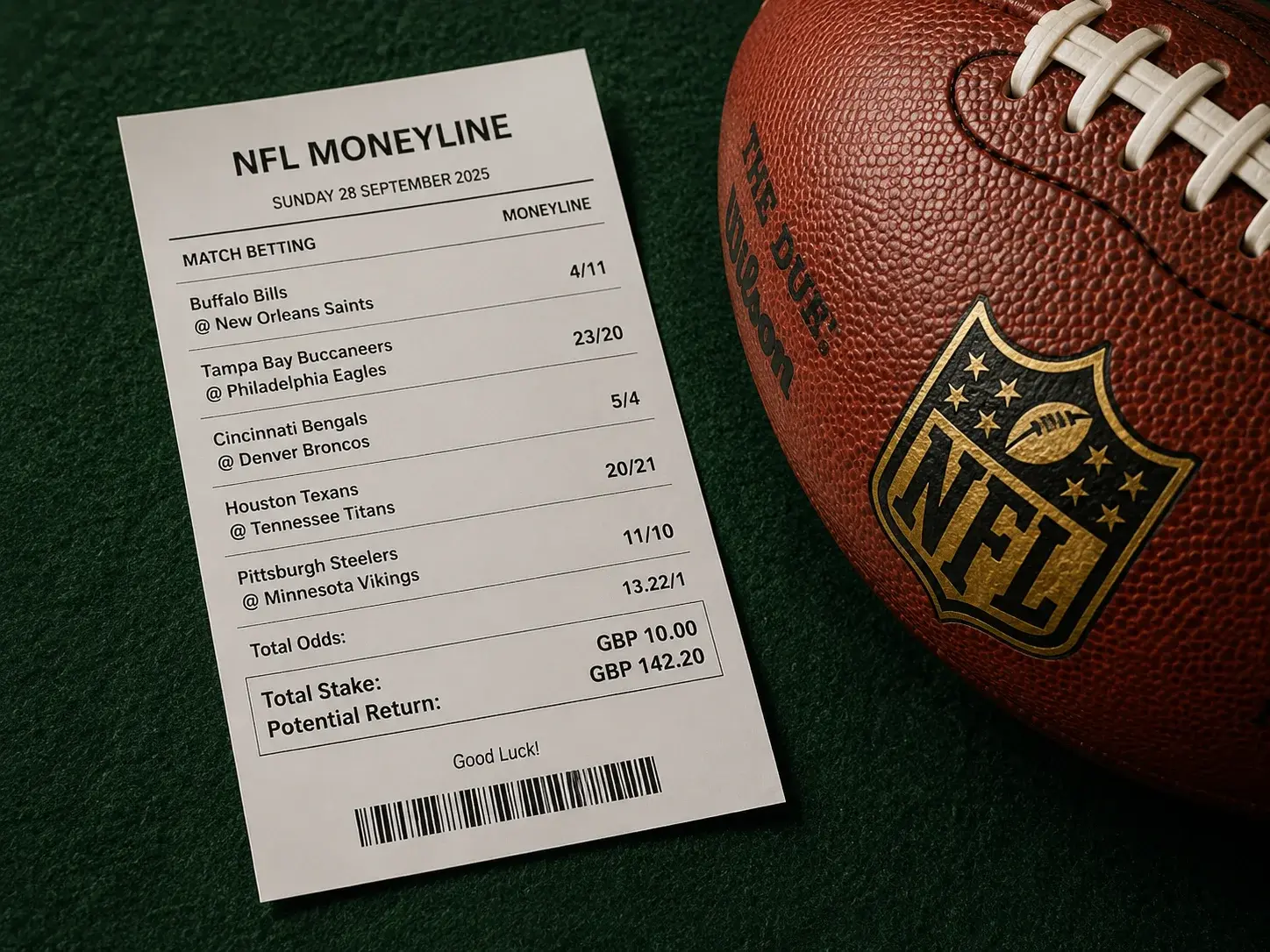
The Sunday acca is a ritual for a lot of UK NFL bettors. Four or five moneyline favourites, combined into a single slip, chasing a return that any individual leg could never deliver. I understand why people do it. I also understand the mathematics, and they are not kind.
Take four favourites each priced at 1/2 (decimal 1.50). Individually, each has an implied win probability of about 67%. The accumulator’s combined odds are roughly 4.06 decimal — a £10 stake returning £40.60. But the actual probability of all four winning is 0.67 to the power of four, which is about 20%. The breakeven point for the acca is 24.6%. You need all four favourites to win at a rate that exceeds their collective implied probability, which means each leg needs to individually outperform its price.
That does not mean NFL moneyline accas are always a losing proposition. It means they require selectivity. Stacking four short-priced home favourites because they are all “supposed to win” is a fast route to frustration. The NFL’s competitive balance ensures that even heavy favourites lose at home with uncomfortable regularity — any given Sunday, as the cliche goes.
Where moneyline accas work better is in building two- or three-leg combinations where each selection has a genuine analytical basis, not just a short price. If you have identified three games where the market has underpriced the favourite — perhaps because of injury news that has not yet moved the line, or a schedule spot that favours one team disproportionately — a small moneyline acca can deliver solid returns without the lottery-ticket odds of a five- or six-leg bet.