
For the first two seasons I bet on NFL, I used the moneyline for everything. Favourites, underdogs, playoffs, preseason — moneyline, moneyline, moneyline. It was simple: pick the winner, collect if they win. Then I started tracking my results properly and discovered that my hit rate was decent but my return on investment was negative because the juice on heavy favourites was eating my profits. That realisation forced me to learn spread and totals betting, and the shift transformed how I approached NFL wagering. Each bet type exists for a reason, serves a different analytical purpose, and carries a different risk-reward profile. The question is not which one is “best” — it is which one fits the game you are analysing and the edge you believe you have found.
Sports betting accounts for 56.64% of UK gambling revenue, making it the largest segment of the market, and these three core bet types — spread, moneyline, and totals — form the foundation of that activity for NFL bettors. Understanding when to use each one is arguably the most important skill in building a sustainable NFL betting approach.
Risk and Reward Profiles: Maximizing Betting Margins
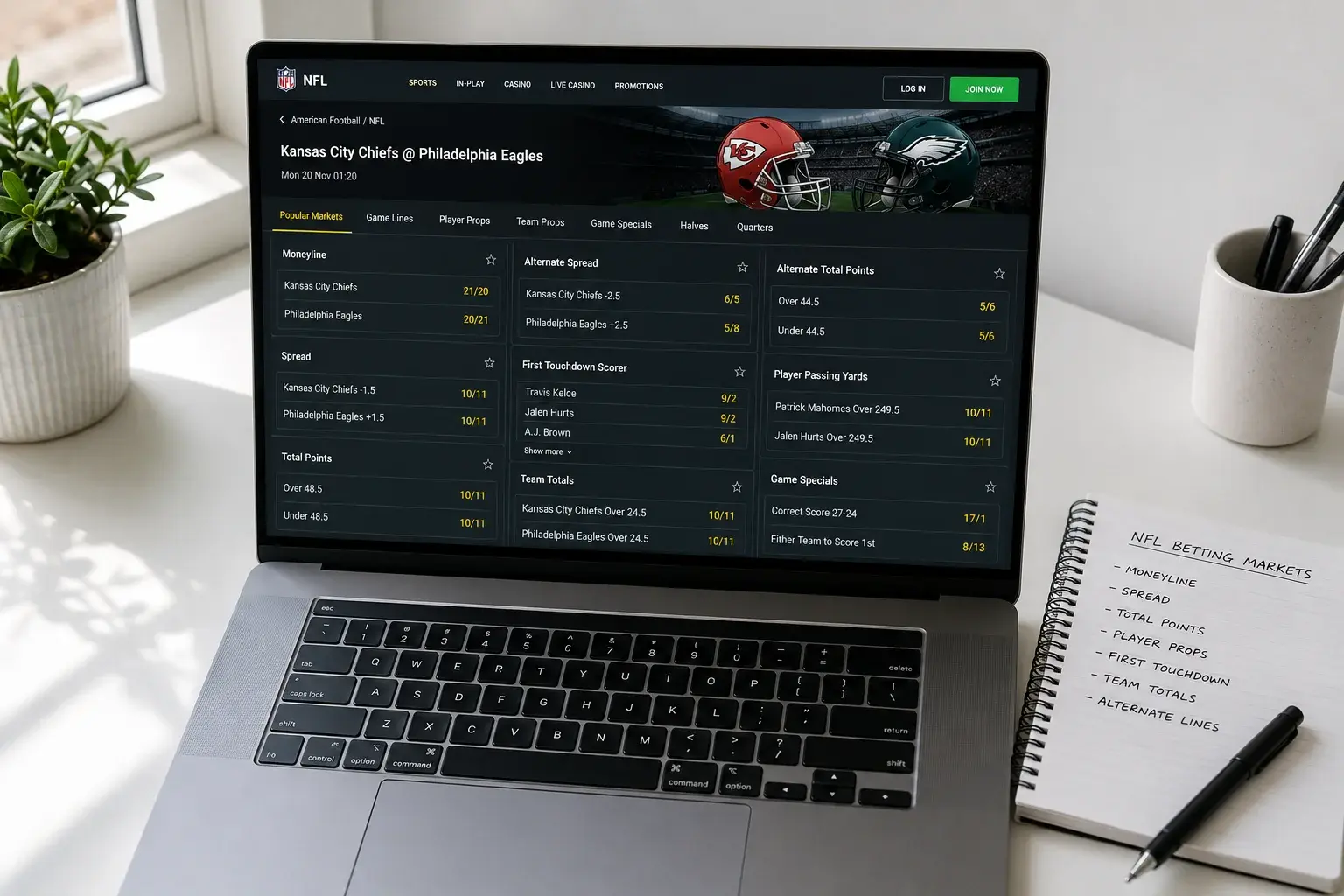
The point spread is designed to create an approximately even-money proposition on every game. The favourite gives points, the underdog receives them, and the bookmaker sets the line so that both sides attract roughly equal action. For the bettor, this means the payout on a spread bet is close to even money (typically 10/11 or 5/6 at UK bookmakers), regardless of whether you are backing a heavy favourite or a significant underdog.
The risk-reward profile is consistent: you are almost always risking slightly more than you stand to win, and the edge comes from the accuracy of your handicapping rather than from finding a large payout. Spread betting rewards bettors who are good at predicting margins of victory, not just winners. If you consistently pick the right side at even-money odds, the return compounds steadily.
Moneyline betting has a variable risk-reward profile that shifts dramatically depending on the matchup. Backing a heavy favourite at 1/4 means risking £4 to win £1 — a poor return if the favourite occasionally loses. Backing a significant underdog at 4/1 means a small stake can produce a large return, but the win rate will be low. The moneyline is best suited for games where you have a strong view on the outright winner and where the odds offer value relative to the true probability.
Totals betting removes the question of who wins entirely and asks only how many combined points will be scored. The payout structure is similar to spread betting — close to even money on both the over and under. The analytical requirement is different: instead of evaluating team strength and matchup dynamics, you are evaluating scoring potential, which depends on offensive efficiency, defensive quality, pace of play, and situational factors like weather and rest.
Bookmaker Margins: Where Is the Lowest Vig?
The bookmaker’s margin — the vig, juice, or overround — varies across bet types and across games. Understanding where the margin is lowest helps you allocate your bets toward the markets where you are getting the fairest price.
Spread bets typically carry the tightest margins on NFL games because they attract the highest volume. The standard vig on an NFL spread at a major UK bookmaker is 4-6%, expressed as both sides being priced at 10/11 or similar. The global sports betting market, valued at $125.12 billion in 2026 and projected to reach $325.71 billion by 2035, drives competitive pressure that keeps spread margins tight on high-profile sports.
Moneyline margins vary by the size of the mismatch. On a closely matched game (pick’em or a 1-point spread), the moneyline margin is similar to the spread margin — both sides are priced near even money. On a heavily lopsided game where the favourite is 1/5 and the underdog is 7/2, the combined margin can balloon to 8-12% because the bookmaker prices the favourite very short and the underdog at odds that do not fully reflect the true probability.
Totals margins sit between spreads and moneylines, typically in the 5-7% range. They attract slightly less volume than spreads but significantly more than moneylines on lopsided games, which keeps the pricing competitive. For bettors who want the best possible price, the general rule is: spread first, totals second, moneyline third — unless the moneyline on a closely matched game offers a better implied probability than the spread.
When to Pick Which: A Scenario-Based Decision Framework
Rather than defaulting to one bet type for every game, I use a simple decision framework based on the strength and nature of my view.
If my view is about the margin of victory — “this team wins by a touchdown” — I bet the spread. The spread directly prices the margin, and my edge is in predicting how many points separate the teams. Legal wagers on the NFL season reached an estimated $30 billion in 2025, and the spread is the market that absorbs the majority of that handle because it is the most analytically tractable bet for handicappers.
If my view is about the winner but the spread feels too tight or too wide — “this underdog wins outright but I would not take them at +2.5” — I bet the moneyline. The moneyline lets me express a view on the winner without needing an opinion on the margin. This happens most often with underdogs that I think are genuinely better than the market suggests: the moneyline pays more than the spread because I am taking on more risk (they need to win, not just cover), and if I truly believe they are the better team, the additional return compensates for that risk.
If my view is about the game script rather than the outcome — “this will be a defensive slugfest” or “both offences are going to score at will” — I bet the total. Totals let me separate my scoring-environment view from any opinion about which team wins. I find this particularly useful for games where I have no conviction about the winner but have a strong view on the style of play based on matchup analysis.
If my view spans multiple dimensions — “this team wins in a high-scoring game with a rushing-heavy game plan” — I consider a same-game parlay rather than a single bet, but I only do this when the individual legs each represent a genuine analytical view rather than a narrative convenience.
Mixing Bet Types Across an NFL Betting Week
A well-constructed NFL betting week rarely consists of 10 spread bets or 10 moneyline bets. More typically, it is a mix: three or four spread bets where I have a margin view, one or two totals where the scoring environment is the play, and perhaps one moneyline underdog where I think the market has the winner wrong.
The key is matching the bet type to the strength of the analytical view. If my handicapping says a team is 3 points better than the market suggests but the spread is -3, the spread bet is a push proposition — the moneyline might offer better value because the team is likely to win even if they do not cover. If my analysis points to a low-scoring game but the total is already set at 38.5, the under might be the play even though the standard-looking total masks the fact that the number is already low.
Diversifying bet types also diversifies your exposure to bookmaker margin. If all your bets are on lopsided moneylines, you are paying the highest vig the market charges. If you mix in spreads and totals where the margin is tighter, the blended vig across your portfolio decreases — which directly improves your long-term expected return even without improving your analytical accuracy.