The first time I looked at an American sportsbook’s NFL odds, I genuinely could not tell whether the team I wanted to back was priced at good value or not. The numbers had plus and minus signs, the vig was expressed as a standard “-110” that I had never seen before, and the interface assumed familiarity with concepts that no UK bookmaker had ever asked me to understand. It took me the better part of an afternoon to map the American system onto the fractional and decimal odds I had grown up with. That experience highlighted something that gets overlooked in most NFL betting guides: the UK and US betting landscapes are not just different languages for the same thing. They are structurally distinct in ways that affect how you bet, what protections you have, and which markets are available to you.
US sports betting revenue reached $16.96 billion in 2025, growing 22.8% year on year, with a total handle of $166.94 billion. The UK market operates at a different scale and under a fundamentally different regulatory model. Understanding those differences is not academic — it has practical implications for any UK punter who consumes American NFL betting content, follows US-based analysts, or wonders whether the grass is greener on the other side of the Atlantic.
Odds Formats Compared: Maximizing Value in the UK
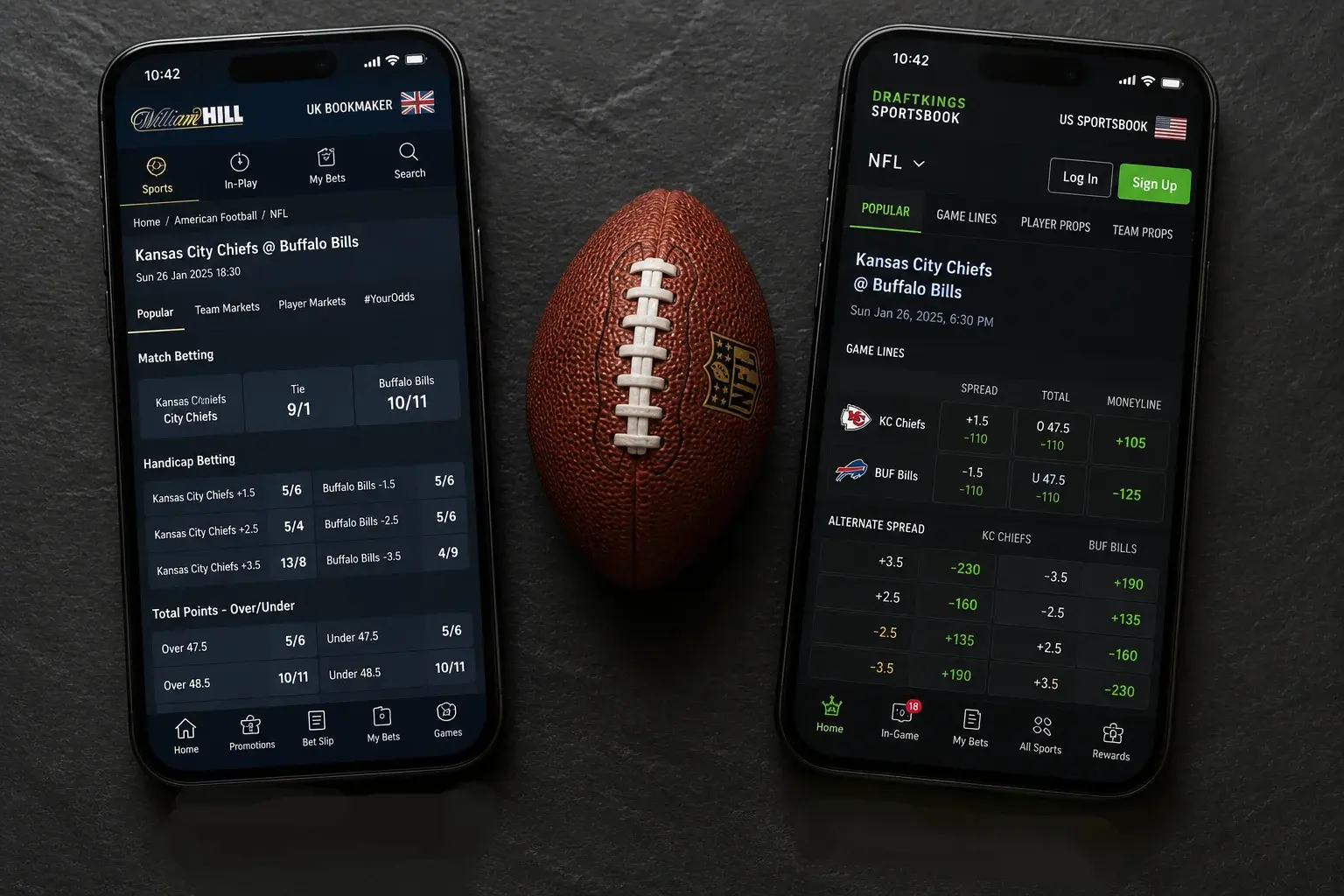
The most visible difference is the odds format. UK bookmakers default to fractional odds (5/1, 11/8, 4/9) for the simple historical reason that British horseracing — the foundation of the UK betting industry — has used fractional odds for centuries. Decimal odds (6.00, 2.38, 1.44) are available as a toggle at every UK bookmaker, and many European-influenced bettors prefer them because the return calculation is simpler: multiply your stake by the decimal number.
American sportsbooks default to moneyline odds (+500, -110, -225), which express the relationship between risk and return relative to a $100 baseline. A +500 line means a $100 bet returns $500 profit; a -225 line means you need to risk $225 to profit $100. The format is intuitive once you understand the convention, but it is genuinely alien to a UK bettor encountering it for the first time.
The important point is that odds format does not affect the bet itself. Fractional 5/1, decimal 6.00, and American +500 are identical prices — the same probability, the same payout, the same bookmaker margin. The difference is purely presentational. Where it matters is when you are comparing prices across markets: if a US analyst says “take the Chiefs at -155” and you want to find the equivalent at your UK bookmaker, you need to convert (roughly 8/13 in fractional, or 1.65 in decimal). Most modern betting apps offer a format toggle, which eliminates the mental arithmetic.
National vs State-by-State: How Regulation Differs
Regulation is where the UK and US diverge most fundamentally, and the difference has real consequences for bettors. The UK operates under a single national framework administered by the Gambling Commission. Every operator serving UK customers must hold a UKGC licence, and the regulatory requirements — consumer protection, responsible gambling tools, advertising standards — apply uniformly across the country. The number of licensed operators in the UK stood at 2,179 in early 2025, down 3.7% year on year, reflecting a market where regulation is tightening and compliance costs are rising.
The US has no equivalent national framework for sports betting. Following the Supreme Court’s 2018 decision that struck down the federal ban, each state sets its own rules. Some states have fully legal online betting with multiple operators; others restrict betting to in-person venues; others have not legalised it at all. The result is a patchwork where a bettor in New Jersey has access to dozens of apps while a bettor in Texas has none. UK bettors benefit from a simpler situation: if a bookmaker holds a UKGC licence, you can use it from anywhere in the country.
The regulatory difference also affects consumer protection. UK bettors have access to the Alternative Dispute Resolution (ADR) process, GAMSTOP self-exclusion, mandatory deposit limits, and the statutory levy that funds treatment and research. US protections vary by state — some states require similar tools, others have minimal requirements. The UK framework is, by most measures, more comprehensive for consumer protection, though it comes with tighter promotional restrictions and the new financial vulnerability checks that some bettors find intrusive.
Market Availability and Operator Landscape
The UK has a mature, consolidated operator market dominated by a handful of large companies. Flutter Entertainment, with projected UK revenue of £2.36 billion in 2025, and Entain, at £2.04 billion, together account for a substantial portion of the UK’s sports betting revenue. Below them sit a long tail of mid-tier and smaller operators, all competing for a customer base that is not growing as rapidly as the US market.
The US market is younger, faster-growing, and more fragmented. DraftKings, FanDuel (owned by Flutter), BetMGM and Caesars are the dominant operators, but new entrants continue to launch in newly legalised states. The competitive intensity means US operators spend aggressively on promotions — welcome bonuses, odds boosts, and loss-back offers that often exceed what UK bookmakers provide in headline terms, though the terms and conditions can be more complex.
For NFL betting specifically, market depth at the top-tier UK operators is comparable to what US sportsbooks offer. A major UK bookmaker will carry 100-plus markets on a primetime NFL game, including detailed player props, bet builders, and alternative lines. The gap is narrower than many UK bettors assume — the perception that US sportsbooks are inherently superior for NFL is based partly on marketing and partly on the assumption that Americans must know their own sport better. In reality, the analytical tools and data feeds that UK operators use are often sourced from the same providers.
Accumulators vs Parlays: Cultural Betting Preferences
The cultural differences in how UK and US bettors approach NFL are genuinely interesting and worth understanding, because they influence the types of content and analysis available in each market.
UK bettors have a deep cultural affinity for accumulators — multi-leg bets combining selections across several games. The Saturday football acca is a ritual, and that habit transfers directly to NFL Sunday. UK bookmakers cater to this with acca insurance, accumulator boosts, and acca-specific promotions that have no direct equivalent in the US market.
US bettors, by contrast, have traditionally been more single-bet oriented, with a focus on the point spread as the dominant market. Parlays (the US equivalent of accas) have grown rapidly since legalisation, particularly same-game parlays, but the cultural default in American sports betting is still the individual spread bet. The US market also has a stronger tradition of “sharp” betting — high-volume, analytically driven wagering by semi-professional bettors whose activity moves lines.
For UK punters consuming US-based NFL betting content, this cultural difference matters. American analysts often discuss spreads and totals as standalone bets with independent expected value calculations. UK betting culture tends to view these as building blocks for accumulators, which introduces compounding margin that the American analysis does not account for. If a US analyst says a bet is “+EV” (positive expected value), that assessment applies to the single bet — the moment you fold it into a five-leg acca, the compounding bookmaker margin may erase the edge entirely.