
My first full NFL betting season was a mess because I treated every week the same. Week 1 got the same approach as Week 14, playoff games got the same unit sizing as August exhibition matches, and I completely ignored the draft and free agency as betting opportunities. The result was a flat bankroll curve punctuated by unnecessary losses in spots where I should not have been betting at all — preseason games with third-string quarterbacks playing the entire second half — and missed opportunities in windows where the market was genuinely inefficient.
The NFL season is not one long event. It is a series of distinct phases, each with its own market characteristics, its own information dynamics, and its own strategic opportunities. The NFL ran a record seven international games in 2025, extending the calendar further and adding new wrinkles for UK-based bettors who can attend London fixtures in person. Understanding which phase you are in — and adjusting your betting approach accordingly — is one of the simplest edges available.
Preseason Markets: Spotting Value Early at UK Bookies
The NFL preseason runs from early August through the first week of September, with each team playing three exhibition games. These games serve a single purpose for the teams: evaluating fringe roster players competing for the final spots. Starters play limited minutes, sometimes sitting out entirely, and game plans bear no resemblance to what coaches will deploy in the regular season.
For bettors, preseason is largely a trap. Bookmakers offer basic markets — moneyline, spread, total — but the pricing is inherently unreliable because the participants are uncertain. A team’s starters might play the first quarter and then give way to backups who may not even make the final roster. The information asymmetry is extreme: coaching staffs know exactly how they plan to use their players, and bettors are guessing based on beat-reporter speculation.
I skip preseason betting entirely. The risk-reward is poor, the markets are thin, and any profit you earn is likely offset by the variance of betting on games where the competitors are effectively unknown. The one exception I would consider is a preseason total in a game where both head coaches have publicly stated they will rest all starters — those games tend to be low-scoring, and the total is sometimes set too high because the bookmaker defaults to a standard preseason number rather than adjusting for the specific circumstances.
Regular Season: 18 Weeks of Peak Market Depth
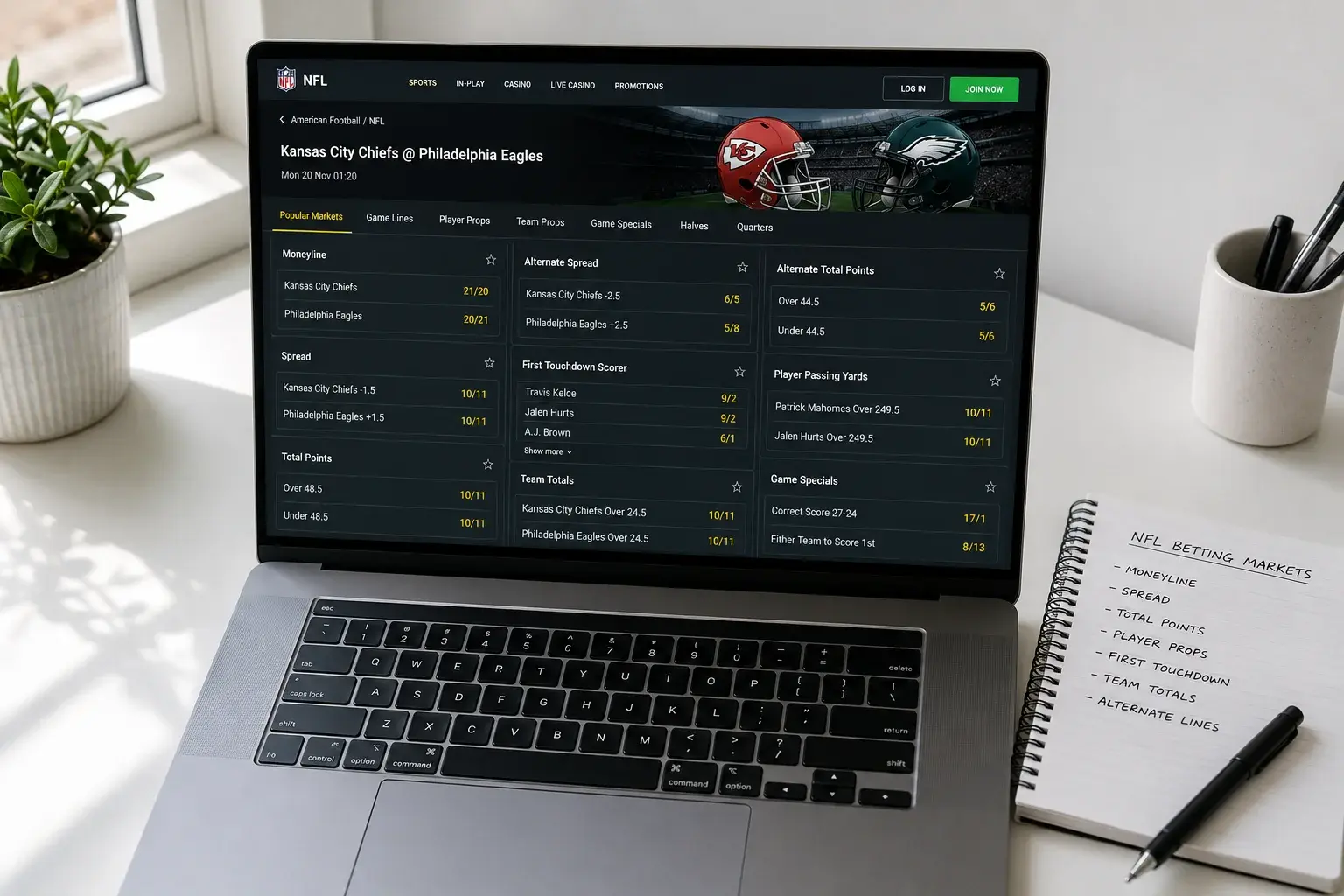
The regular season is the core of NFL betting and the phase where market depth, data availability and analytical tools are at their peak. Eighteen weeks, 272 games, and — at the major UK bookmakers — upwards of 100 markets per game. This is where the bulk of your betting activity should occur, and it is the period that justifies the investment of time in research and analysis.
Henry Hodgson, General Manager of NFL UK and Ireland, has described the sport’s position in the UK as very healthy with significant room for growth — an assessment backed by the increasing volume of NFL betting at UK bookmakers each season. The regular season is where that growth is most visible. UK punters who a decade ago might have bet on one or two primetime games now routinely engage with the full Sunday slate, Thursday Night Football and Monday Night Football.
The regular season itself has internal phases that matter for betting. Weeks 1 through 4 are the most volatile because the sample size of current-season data is tiny and the market is still calibrating team strengths based on pre-season expectations. I bet more conservatively during this opening stretch, focusing on situations where I have a strong structural view (travel spots, coaching mismatches) rather than trying to out-handicap the market on team quality with three games of evidence.
Weeks 5 through 12 are the sweet spot. Enough data has accumulated to build meaningful models, injuries have reshuffled the landscape in ways the pre-season projections did not anticipate, and the market is efficient but not perfectly so. This is the window where disciplined analytical work is most likely to produce an edge. A single Sunday in this phase consistently generates more betting handle than entire weeks of MLB or NBA action, which tells you how much attention — and money — the market attracts.
Weeks 13 through 18 are shaped by playoff implications. Teams fighting for a playoff spot play with desperation; teams that have clinched rest starters in Week 18. The information edge in this phase comes from understanding which games are meaningful and which are not — a distinction that affects effort, game-planning intensity, and ultimately scoring.
Playoff Rounds: How Odds Tighten and Markets Shift
The NFL playoff structure — Wild Card, Divisional Round, Conference Championships, Super Bowl — compresses the field from 14 teams to one over four weekends in January and February. From a betting perspective, the transition from regular season to playoffs produces measurable changes in market behaviour.
Spreads tighten. The average playoff spread is significantly smaller than the regular-season average because the talent gap between playoff teams is narrower than across the full 32-team league. Games that would carry a 7-point spread in October might be priced at 3 or 4 in the playoffs, which means single plays have a larger proportional impact on the outcome relative to the spread. This heightened variance makes individual game predictions less reliable, which is something your unit sizing should reflect.
Totals also behave differently. Playoff games, particularly in the Divisional Round and Conference Championships, trend slightly toward the under compared to their posted totals. Preparation time increases, defensive schemes are more targeted, and the stakes incentivise conservative play-calling — teams protect leads rather than running up scores. Super Bowl betting breaks this pattern somewhat, with the extended two-week preparation period often producing well-executed offensive football on both sides.
Public money floods into the playoffs, particularly the Conference Championships and Super Bowl, which increases the influence of recreational bettors on line movement. If you have a contrarian view backed by analytical support, the playoff window can offer value precisely because the public is driving lines in directions that do not always reflect true probability.
Off-Season Windows: Free Agency, Draft and OTAs
The off-season is when most bettors switch off, which is precisely why it deserves attention. Free agency opens in mid-March, the NFL Draft takes place in late April, and Organised Team Activities (OTAs) run through May and June. Each window produces information that reshapes the futures markets — Super Bowl winner, division winners, season win totals, MVP — and the bettors who engage during these windows get first access to prices that will look very different by September.
Free agency is the most impactful off-season event for futures betting. A franchise quarterback changing teams, a dominant pass rusher signing with a contender, or a team losing three starters to free agency can move Super Bowl odds by several points. Since the UK has hosted 39 or more regular-season NFL games since 2007, UK bookmakers are increasingly attuned to off-season events and open their futures markets earlier and wider than in previous years.
The draft is the second major catalyst. First-round picks — particularly quarterbacks and premium pass catchers — can immediately alter a team’s trajectory. Win-total lines are often adjusted within hours of a surprise draft selection. If you have done your pre-draft research and have a strong view on how a specific pick changes a team’s outlook, the window between the pick announcement and the market adjustment is one of the few true “speed edges” available to retail bettors.
OTAs and training camp generate softer information — depth-chart battles, rookie development reports, scheme changes — but they matter for specific markets. A rookie quarterback winning the starting job in June can halve his Offensive Rookie of the Year odds by September. If you are tracking these reports through beat writers and team sources, you can position yourself in player-award futures before the market catches up.