
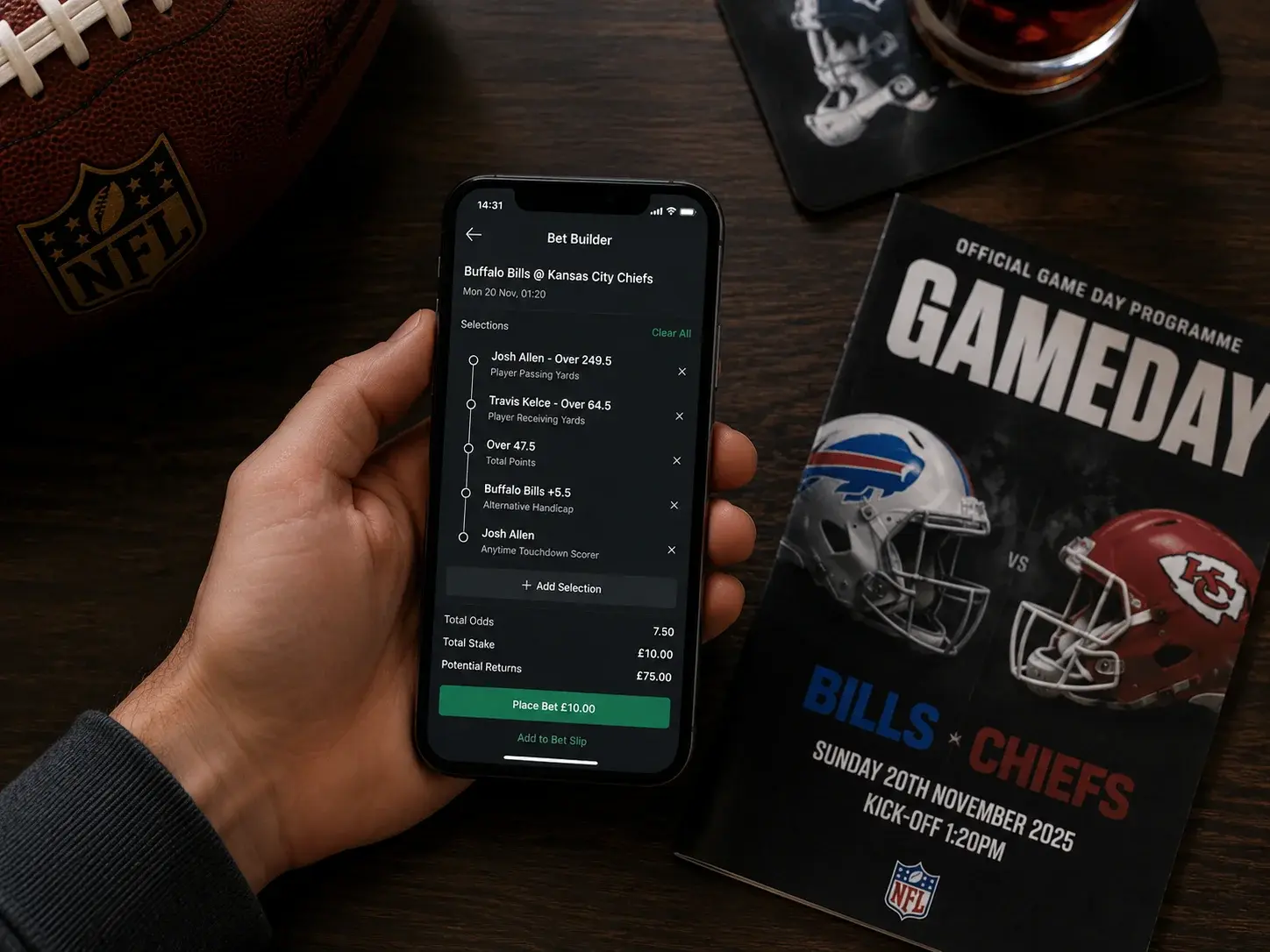
The first bet builder I ever assembled felt like a revelation. Instead of picking a game winner and moving on, I could combine the result with a player to score a touchdown, the total points going over a certain number, and a quarterback to throw for 250-plus yards — all in one slip, all from one game. The odds were huge. The bet lost, obviously. But the process of thinking through how those selections connected to each other changed how I analysed NFL games from that point on.
Bet builders have become one of the most popular features at UK bookmakers, and for good reason: they let you construct a bet that reflects your specific view of how a game will unfold, rather than forcing you into a pre-set market. Flutter Entertainment, the largest UK operator with projected revenue of £2.36 billion in 2025, and Entain, the second-largest at £2.04 billion, have both invested heavily in bet-builder technology because it drives engagement and — from the bookmaker’s perspective — carries wider margins than standard single bets.
That margin point matters, and I will be upfront about it throughout this guide. Bet builders are fun. They are analytically interesting. They can also be expensive if you do not understand how the pricing works.
Bet Builder Pricing: Combining Markets at UK Bookies
If you place a standard accumulator across multiple games, the bookmaker multiplies the individual odds together because the outcomes are independent — the result of an early game has no bearing on a late game. Bet builders work differently because all selections come from the same game, which means they can be correlated.
Correlation is the key concept. If you back a team to win and also back the total to go over, those two outcomes are not independent. A winning team is more likely to be involved in a high-scoring game than a low-scoring one, because they need to have scored enough to win. The bookmaker’s algorithm recognises this correlation and adjusts the combined odds downward compared to what a naive multiplication of individual odds would produce.
The adjustment is invisible to you. The bet builder interface shows only the final combined odds, not the individual prices of each leg or the correlation penalty applied. This opacity is by design — it makes it difficult to assess whether the combined price represents good value relative to the true probability. I have found, through tracking my own bet builders over several seasons, that the effective margin on a three-leg builder is typically 15-25% higher than the margin on a single bet in the same game. Add a fourth or fifth leg and the margin widens further.
None of this means bet builders are inherently bad value. It means you need to be more selective about which combinations you build and more disciplined about the price at which you are willing to bet. A well-constructed two-leg builder on strongly correlated outcomes can offer reasonable value. A five-leg builder assembled because “the odds look big” is almost always a losing proposition in the long run.
Choosing Legs: Complementary vs Conflicting Selections
The single most important skill in bet-builder construction is understanding which selections reinforce each other and which contradict each other. ESPN’s Adam Schefter has noted that player prop bets are where things get really interesting, and that observation applies doubly to bet builders, where props form the backbone of most combinations.
Complementary selections are those where one outcome makes the other more likely. If you back a team to win by a comfortable margin, their star running back is more likely to have a high rushing yardage total because winning teams tend to run the ball in the second half to control the clock. Similarly, if you expect a high-scoring game, individual player yardage and touchdown props become more likely because more scoring means more opportunity for skill players to accumulate stats.
Conflicting selections are the trap. Backing the under on total points while also backing a player to score two or more touchdowns creates internal tension — a low-scoring game means fewer touchdowns to go around. The bet builder will still let you combine these selections, and it will give you odds that look attractive, but those odds already reflect the low probability of both events occurring simultaneously. You are not getting a bargain; you are betting on an unlikely scenario at roughly fair odds minus margin.
My approach is to start with a game thesis — how do I expect this game to play out? — and then select legs that are consistent with that thesis. If I think a game will be a defensive grind, I build around unders, low individual yardage totals, and the team with the better defence winning by a tight margin. Every leg should tell the same story. The moment a leg contradicts my thesis, I remove it, regardless of how much it would boost the combined odds. Understanding NFL prop markets in depth is essential here, because props are the building blocks of every effective bet builder.
Which UK Bookmakers Offer NFL Bet Builders
Not all bet builders are created equal. The underlying algorithms, the number of available selections, and the correlation adjustments vary significantly across operators. A bet builder at one bookmaker might offer 8/1 on the same combination that another bookmaker prices at 6/1, and the difference is entirely down to how aggressively each operator’s algorithm penalises correlated outcomes.
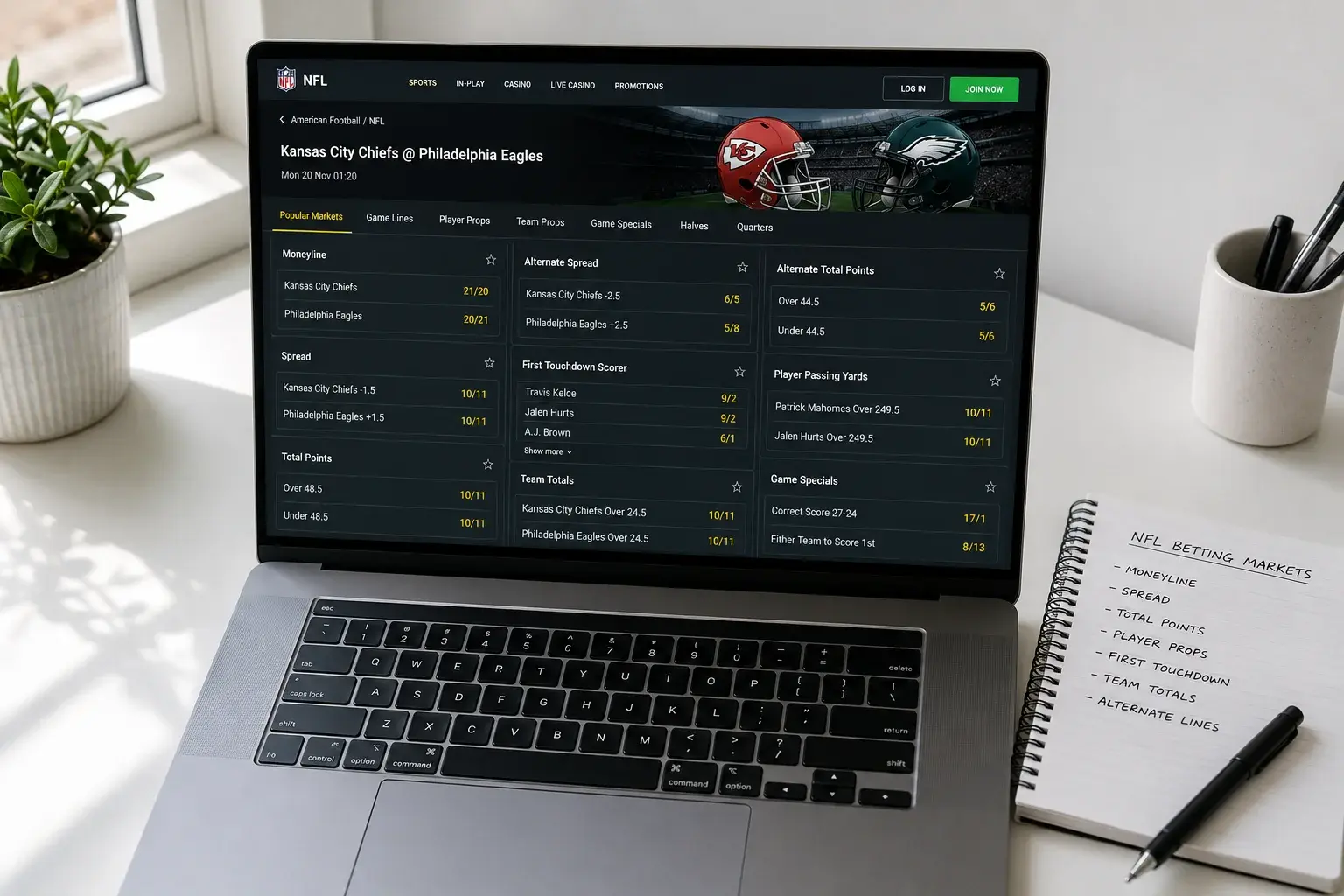
The major operators in the Flutter group tend to offer the deepest NFL bet-builder markets, with 30 or more selectable outcomes per game covering match result, handicaps, totals, player rushing and receiving yards, touchdown scorers, passing stats and game specials. Entain’s platforms also carry extensive NFL builder options, though the specific markets available can vary between their individual brands.
Smaller operators sometimes offer bet builders with fewer NFL selections — perhaps 15 to 20 per game — which limits the combinations you can construct. For straightforward two- or three-leg builders this is rarely a problem, but if you want to include niche player props (such as a specific player’s reception count or a quarterback’s interceptions), the larger operators are more likely to carry those markets.
One practical tip: check whether the bet-builder feature is available for all NFL games or only for high-profile matchups. Some bookmakers restrict builder access to primetime and playoff games, where their data feeds and risk models are more robust. Regular-season early-window games occasionally have reduced builder availability, particularly for smaller-market teams.
A Worked Example: Building an NFL Bet Step by Step
Let me walk through a realistic bet builder from start to finish. Suppose the upcoming game is a divisional rivalry where Team A is favoured by 3.5 points at home, the total is set at 45.5, and Team A’s running back has been averaging 85 rushing yards per game.
My game thesis: Team A wins comfortably at home, controls the second half with a strong rushing attack, and the total stays under because Team A’s defence forces punts and short possessions. Based on that thesis, I select three legs. First, Team A to win — consistent with the favourite covering at home in a divisional game. Second, Team A’s running back to rush for over 79.5 yards — consistent with a run-heavy second half when protecting a lead. Third, under 45.5 total points — consistent with a defensive game where one team dominates possession.
Now I check for conflicts. Does Team A winning conflict with the under? Not necessarily — they can win 24-10, which is under 45.5. Does the running back yardage conflict with the under? Slightly — high rushing yardage sometimes accompanies higher scoring — but a clock-controlling ground game actually suppresses the total by eating time without scoring on every possession. The legs are broadly consistent.
The individual prices might be something like Team A to win at 4/9, running back over 79.5 yards at 10/11, and under 45.5 at 10/11. Multiplied naively, that gives roughly 3.3/1. The bet builder offers 2.8/1 after the correlation adjustment. Is 2.8/1 fair? I compare it to my estimated probability of all three outcomes occurring together — if I think the combined probability is above 26%, the bet offers value. If not, I pass.